
Earbuds were the breakout D2C category of India’s last decade. A handful of homegrown brands, led by boAt, built thousand-crore businesses selling affordable wireless audio on Amazon and Flipkart. In 2026 the category looks very different: volumes have stopped growing, Chinese-owned brands are gaining share, offline retail is coming back, quick commerce has become a real channel, and the biggest “Indian” brands now assemble most of their earbuds in India but still rely on Chinese-designed chips.
This is the first in our series of category breakdowns. It covers market size, brand share, channels, quick commerce, new entrants, what drives demand, how often people buy again, Make in India, and China’s role, using the latest data from IDC, Counterpoint, company filings and news reports.
The category at a glance
| Metric | Latest figure | Source |
|---|---|---|
| Earwear shipments, 2025 | 84.7 million units, up 1.4% | IDC |
| TWS share of earwear | 70.2% (2025), 71.1% (Q2 2026) | IDC |
| Average selling price, earwear | US$17.5 in 2025; US$17.8 in Q2 2026 | IDC |
| Approximate market value, earwear 2025 | About US$1.5 billion | Our calculation: 84.7M units × US$17.5 |
| TWS shipments, Q2 2026 | Down 9.3% year on year | IDC |
| Market leader | boAt, 32.3% of TWS shipments (Q2 2026) | IDC |
| Online share of TWS | About 76% (Q1 2025) | Counterpoint |
| Assembled in India | Almost three-fifths of TWS devices (Q1 2025) | Counterpoint |
India’s earwear market grew 1.4% to 84.7 million units in 2025, and IDC said TWS volumes were flat “due to market maturity and longer replacement cycles” (IDC). In the second quarter of 2026, earwear shipments fell 9.1% to 18.0 million units and TWS fell 9.3% (IDC). Counterpoint saw the same pattern in the first quarter: shipments down about 2%, but revenue up 7% because average prices rose 9% (Counterpoint). Fewer units, higher prices: that sums up the category in 2026.
Market share by brand
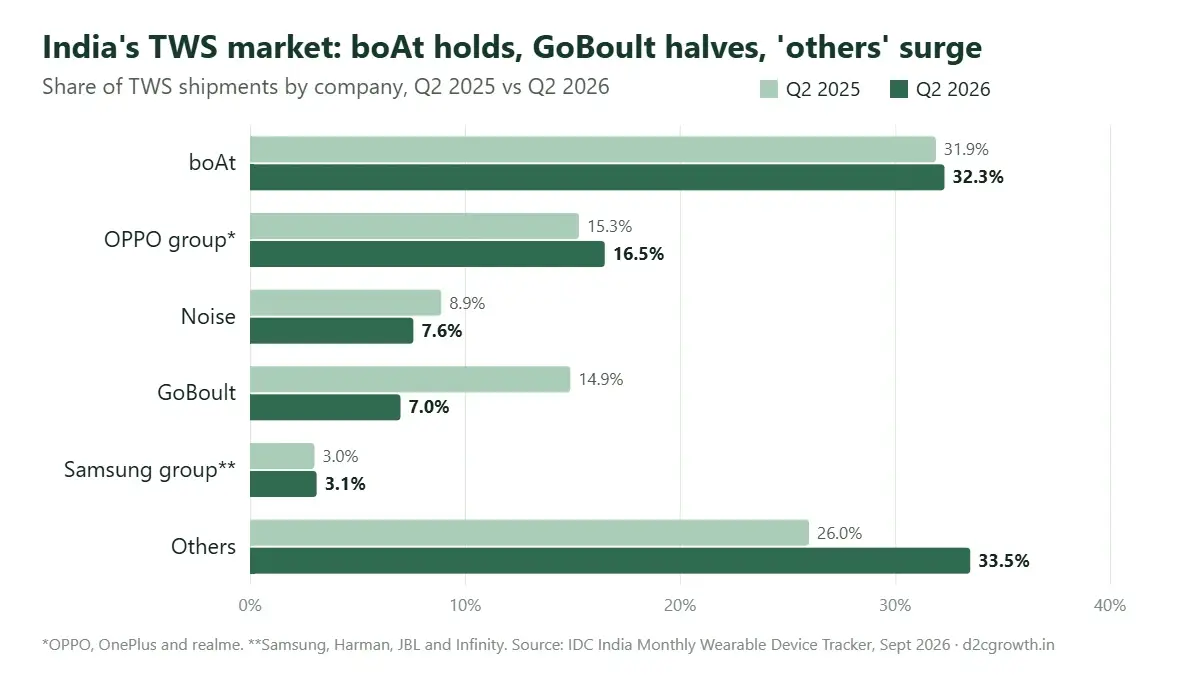
| Company | Q2 2025 share | Q2 2026 share | Shipments, YoY |
|---|---|---|---|
| boAt (Imagine Marketing) | 31.9% | 32.3% | −8.3% |
| OPPO (incl. OnePlus, realme) | 15.3% | 16.5% | −2.4% |
| Noise (Nexxbase) | 8.9% | 7.6% | −22.3% |
| GoBoult | 14.9% | 7.0% | −57.2% |
| Samsung (incl. Harman, JBL, Infinity) | 3.0% | 3.1% | −5.5% |
| Others | 26.0% | 33.5% | +16.7% |
Three things stand out:
- boAt is still far ahead. It held 32.3% of TWS shipments and 34.7% of all earwear in Q2 2026, even though its shipments fell 8.3%.
- The three big Indian brands are losing ground. boAt, Noise and GoBoult together held 55.7% of TWS shipments in Q2 2025 and 46.9% a year later (our addition of IDC’s figures). GoBoult’s shipments more than halved. Counterpoint had already flagged this in early 2025, when Chinese brands reached a 15% share and global brands such as JBL, Apple, CMF and Samsung doubled their shipments (Counterpoint).
- “Others” is the fastest-growing group. Smaller and newer brands grew 16.7% while every top-five company shrank, taking their combined share from 26.0% to 33.5%. The market is fragmenting again.
Offline vs online
Earbuds are still mainly an online category. Counterpoint estimated online channels at about 76% of TWS sales in Q1 2025 (Counterpoint). boAt, the largest brand, earned 71% of its FY25 revenue online, through Amazon, Flipkart and its own website, while also selling through about 12,000 retail stores and 112 distributors (boAt UDRHP via IPO Central).
But growth has moved offline. In Q2 2026, online earwear shipments fell 16.2% while offline grew 2.7%, and offline’s share of all wearables rose from 39.8% to 43.8% (IDC). In 2025, offline earwear grew 9.4% while online fell 3.2% (IDC). Counterpoint’s explanation is simple: buyers want to test sound quality and fit before they buy.
Brands differ a lot here. In a 2024 CMR survey of about 1,000 young buyers, 55% of GoBoult owners and 52% of boAt owners had bought online, while Noise had the stronger offline presence, at 51% (CMR). Offline brings its own problem: IDC warns of “increasingly sophisticated counterfeits in physical retail” (IDC).
Platform split within online
No research firm publishes a platform-by-platform split for earbuds, so this section pieces together what brands have disclosed:
- Amazon and Flipkart still dominate. In boAt’s first IPO filing, about 85% of FY21 sales came from marketplaces such as Amazon and Flipkart, and its own website brought in just 3.2% (Inc42). Its 2025 filing no longer breaks out marketplaces separately, but the online total is still 71%.
- Brand websites are a small slice. Our read: for a low-priced, frequently discounted product, shoppers default to marketplace sales and bank offers, so own-website sales stay small even for the biggest brands.
- Quick commerce is the fastest-growing slice. In February 2025, GoBoult co-founder Varun Gupta said quick commerce was about 10% of its sales and expected it to reach about 20% within 18 months. Nu Republic, a smaller audio and accessories brand, said about 60% of its sales came from quick commerce (Outlook Business).
A reasonable picture for a mass-market earbud brand today is: most online revenue from Amazon and Flipkart, a fast-growing quick-commerce share in the low tens of percent, and a small own-website share. The exact mix varies a lot by brand, and anyone who has the real numbers for their own brand should trust those over any industry average.
How quick commerce is changing the category
Earbuds suit quick commerce well: they are small, light, need no installation, and are often bought on impulse or as a last-minute gift. Counterpoint’s Anshika Jain said in May 2026 that “the expansion of quick commerce is also widening the reach of entry-level devices” (Counterpoint).
- The sweet spot is under ₹1,000. Counterpoint’s Tarun Pathak told Outlook Business that “the sweet spot for electronics purchases via quick commerce is below Rs 1000” (Outlook Business). That matches the market: the sub-₹1,000 band took over 30% of TWS shipments in Q1 2026, up from a year earlier (Counterpoint).
- The shelf keeps getting bigger. India had about 6,280 dark stores in January 2026, according to Redseer (Inc42). Blinkit, Zepto, Instamart and BigBasket even sold the iPhone 18 Pro on launch day in September 2026, although analysts called it a launch-day marketing moment rather than a major sales channel for phones (TechCrunch).
- Non-food is the long-term bet. Google and Deloitte estimate quick commerce could reach US$50 billion by 2030, with non-food categories such as electronics, fashion and beauty making up 45% of spending (TechCrunch).
For brands, quick commerce changes the rules. A dark store stocks a handful of SKUs, so the winners are brands with one or two clear hero products at the right price, not 60-model catalogues. Availability in each store and search ads on the app matter more than marketplace reviews. Our Blinkit sales guide and Zepto Ads guide cover how ranking and ads work on these platforms.
New entrants and challengers
- Smartphone-linked Chinese brands. The OPPO group (OPPO, OnePlus and realme) grew its TWS share from 15.3% to 16.5% in Q2 2026 and is now a clear number two (IDC). These brands can sell earbuds alongside their phones, through the same online and offline channels.
- Nothing and CMF. The fastest-growing TWS brand in 2025, with shipments up 91.5% (IDC).
- Global premium brands. In the over-₹5,000 band, OnePlus, Apple and Samsung together held nearly 70% of shipments in Q1 2026, and premium was the fastest-growing segment (Counterpoint).
- A flood of new models. New SKU launches more than doubled, from over 30 in Q1 2025 to over 60 in Q1 2026 (Counterpoint). Together with the jump in “others” share, this shows that small and new brands are still finding room, especially at low prices and on quick commerce.
What drives the category
- Premium features moving down to mass prices. AI noise cancellation is now in about one in three devices, and the ₹2,001–5,000 band has become an “innovation sweet spot” with features such as spatial audio, head tracking and haptics (Counterpoint).
- Trading up. Average prices rose 9% in Q1 2026 and the premium band grew fastest. IDC’s Vikas Sharma: “pricing is moving higher, and demand isn’t backing off” (IDC).
- The very cheap end. At the same time, sub-₹1,000 earbuds took over 30% of shipments. The middle (₹1,001–2,000) is the band being squeezed.
- Fewer first-time buyers. Counterpoint said growth from first-time urban buyers has slowed, so more of the market now comes from people replacing or upgrading earbuds they already own.
- New form factors. IDC calls the shift to open-ear designs “the bigger story” in earwear. Over-the-ear headphones grew 31.5% in Q2 2026 while neckbands fell 22.9% (IDC).
- Festive sales and gifting. Big marketplace sales and festive gifting concentrate demand into a few weeks of the year. See our Flipkart festive calendar breakdown and Diwali quick-commerce playbook.
How often do customers buy again?
No research firm publishes a standard repurchase interval for earbuds in India, so treat any single number with caution. Here is what the evidence says:
- In a 2021 Counterpoint survey of 1,027 TWS users, half said they planned to buy their next pair “in a year or less” (Counterpoint).
- In CMR’s 2024 survey, 44% of young buyers said they planned to upgrade within the next three months. That’s stated intent, which usually runs ahead of actual buying (CMR).
- By 2025, IDC was citing “longer replacement cycles” as a reason TWS volumes stopped growing (IDC).
Our reading: in the boom years, many buyers replaced cheap earbuds within about a year, for reasons such as a fading battery, a lost bud or a better model at the same price. That cycle is now lengthening as quality improves and buyers pay more. For planning, a brand should measure its own repeat-purchase rate from order data rather than rely on a market average, and should not assume most buyers come back within 12 months.
How Indian brands are using Make in India
Local assembly has grown fast. Almost three-fifths of TWS devices sold in India in Q1 2025 were assembled locally (Counterpoint).
- boAt made 75.83% of its production in India in Q1 FY26, up from 39.65% in FY23, and had made over 75 million units in India by June 2025. Califonix, its joint venture with Dixon Technologies, produced 37.46% of boAt’s units that quarter. boAt plans to localise PCBs, batteries and plastics next and says local production could save 15–20% on import duties (D2C Insider).
- Noise has worked with Optiemus Electronics since 2021 to make TWS earbuds at Optiemus’s plants in Noida (MyMobileIndia).
The catch is that “made in India” mostly means assembled in India. The highest-value parts, the Bluetooth chip and the battery cell, are still largely imported. For comparison, India’s mobile phone industry adds only 18–20% of value domestically, according to the India Cellular and Electronics Association (Business Standard). There is no published figure for earbuds, and with less local component manufacturing than phones, it is unlikely to be higher. Make in India has given brands lower duties and a stronger “Indian” story, but not yet independence from imported parts.
China’s role: supplier and competitor
- Chips. boAt’s 2025 IPO filing lists technology collaborations with Dolby, BES and Wuqi (IPO Central). BES (Bestechnic) is a Shanghai-listed designer of Bluetooth audio chips whose customers include Harman, Xiaomi and Google (EqualOcean). Wuqi Microelectronics is also based in Shanghai (PitchBook). For India’s biggest earbud brand, at least, the core chip partners are Chinese.
- Batteries and components. In 2025-26, China supplied 83.6% of India’s lithium-ion battery imports and 48.9% of its semiconductor imports, according to a Koan Advisory and Institute of Chinese Studies study (Business Standard).
- Competition. The OPPO group, which owns OnePlus and realme, is the number-two TWS seller with 16.5% of shipments. Chinese brands are winning share from Indian ones, not the other way round.
Put simply, China sells Indian brands the parts and competes with them for the customer. Any disruption to chip or battery supply would hit Indian and Chinese brands alike, but Chinese brands with group-level purchasing scale are better placed to absorb it.
Also worth knowing: the economics are thin
| Brand | FY25 revenue | Change | FY25 net profit |
|---|---|---|---|
| boAt | ₹3,073 crore | −1.4% | ₹61 crore |
| Noise | ₹1,048 crore | −24% | ₹3.2 crore (helped by a ₹47 crore deferred tax gain) |
| GoBoult | ₹763 crore | +10% | ₹24 crore |
The three largest Indian brands together earned under ₹90 crore of profit on almost ₹4,900 crore of revenue in FY25. Marketing is a big reason: GoBoult spent ₹177 crore on advertising and promotion, about 23% of its revenue (Entrackr). Even Noise, backed by Bose with a US$10 million investment in December 2023 and a later US$20 million round at a US$470 million valuation, saw revenue fall 24% (Entrackr). In a category with falling volumes, Chinese chips and heavy discounting, scale alone no longer guarantees profit.
What this means for brands
- Pick an end of the market. The growth is in sub-₹1,000 value and above-₹5,000 premium. The ₹1,001–2,000 middle, where many D2C brands were built, is shrinking.
- Build for quick commerce and offline, not only marketplaces. Online share is falling, and both fast-growing channels reward a tight range of hero products and strong store-level availability.
- Win on one feature people can feel. With 60+ launches a quarter, specifications blur together. AI noise cancellation, fit and open-ear comfort are what buyers notice in a store or a review.
- Plan for longer replacement cycles. Retention offers, trade-in or exchange programmes and accessories matter more when customers don’t come back every year.
- Know your supply chain risk. Local assembly helps with duties and the brand story, but chips and cells still come from China. Dual-sourcing and buffer stock for key parts are worth the cost.
Keep reading
- Diwali 2026 on Blinkit, Zepto and Instamart: The Quick-Commerce Playbook for D2C Brands
- How to Increase Sales on Blinkit: Complete Guide for D2C Brands (2026)
- Winning the Amazon Buy Box in India: A Strategic Seller’s Playbook (2026)
- The Complete D2C Growth Playbook for Indian Startups (2026)
Sources
- IDC: India wearable shipments decline in Q2 2026 (Sept 2026)
- IDC: India’s wearables market declines 4.0% to 114 million units in 2025 (March 2026)
- Counterpoint Research: India TWS market Q1 2026 (May 2026)
- Counterpoint Research: India TWS shipments rise 4% in Q1 2025 (May 2025)
- Counterpoint Research: 50% of TWS users likely to upgrade within a year (Dec 2021)
- CMR: TWS and neckband study among Indian youth (May 2024)
- IPO Central: boAt UDRHP breakdown (Oct 2025)
- Inc42: boAt files updated DRHP (Oct 2025)
- Inc42: boAt’s dependence on Amazon and Flipkart (March 2022)
- D2C Insider: boAt hits 75 million Made in India units (Nov 2025)
- MyMobileIndia: Noise and Optiemus partner to manufacture in India (Aug 2021)
- Outlook Business: Mobile accessories find a sweet spot in quick commerce (Feb 2025)
- TechCrunch: In India, the new iPhone can arrive faster than a pizza (Sept 2026)
- Inc42: Inside the dark store festive stock-up strategy (Aug 2026)
- Business Standard: India relies on China for core electronics components in 71 product lines (Sept 2026)
- Business Standard: India’s electronics boom, how much is really made at home? (July 2026)
- EqualOcean: Bestechnic, Google Pixel Buds chip provider, goes public in Shanghai (2020)
- PitchBook: Wuqi Microelectronics company profile
- Entrackr: GoBoult posts ₹763 crore revenue (Feb 2026)
- Entrackr: Bose-funded Noise revenue declines 24% to ₹1,048 crore in FY25 (Feb 2026)