
Every quick-commerce platform now sells ads. What’s different about Zepto isn’t that it has an ads business — it’s why that business can target more precisely than almost anything else in Indian D2C advertising: Zepto’s entire operating model is a dense grid of dark stores, each one serving a tight radius of a few kilometers. That structure, built for 10-minute delivery, happens to double as one of the most granular ad-targeting systems available to Indian brands — down to the pincode, not just the city.
This guide breaks down what that actually means for a D2C brand deciding where to spend its quick-commerce ad budget.

Why Zepto’s ad business is growing so fast
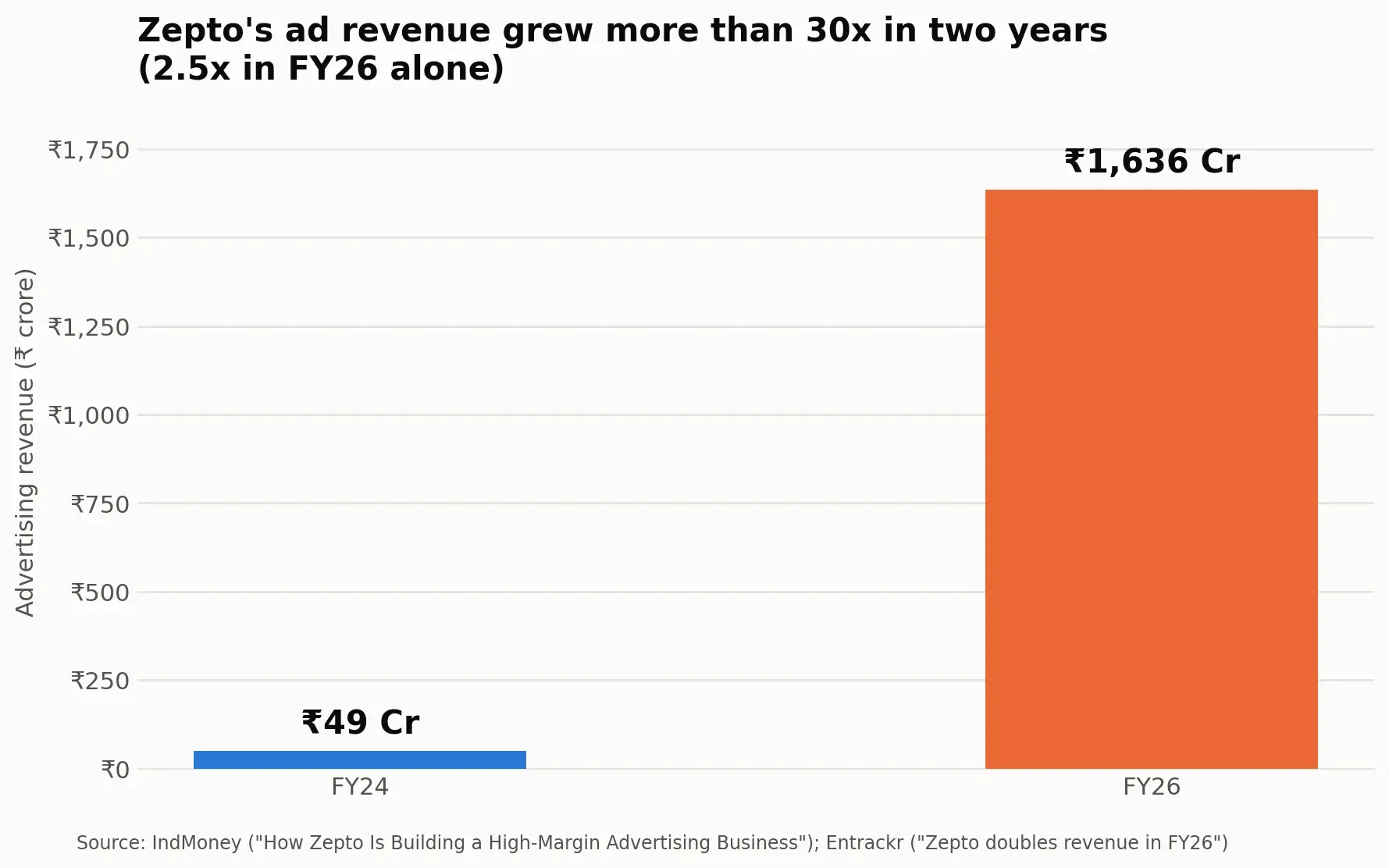
Grocery retail — Zepto’s core business — runs on thin gross margins, typically cited in the 3–5% range. Digital advertising runs at 70–80% gross margins.1 That gap is why every quick-commerce platform is racing to build out ads, and Zepto’s numbers show it: advertising revenue grew from roughly ₹49 crore in FY24 to ₹1,635.7 crore in FY26 — a more than 30x increase in two years, and 2.5x growth in FY26 alone.2,1 For context, Zepto’s total operating revenue for FY26 was ₹22,624 crore (up from ₹11,110 crore in FY25, almost exactly doubling), while losses widened to ₹5,905 crore from ₹4,700 crore.2 Ads are a small slice of total revenue today, but by far the fastest-growing and highest-margin one — which is exactly why platforms like Zepto keep building better targeting tools to sell more of it.
The infrastructure behind the targeting: dark stores, not warehouses
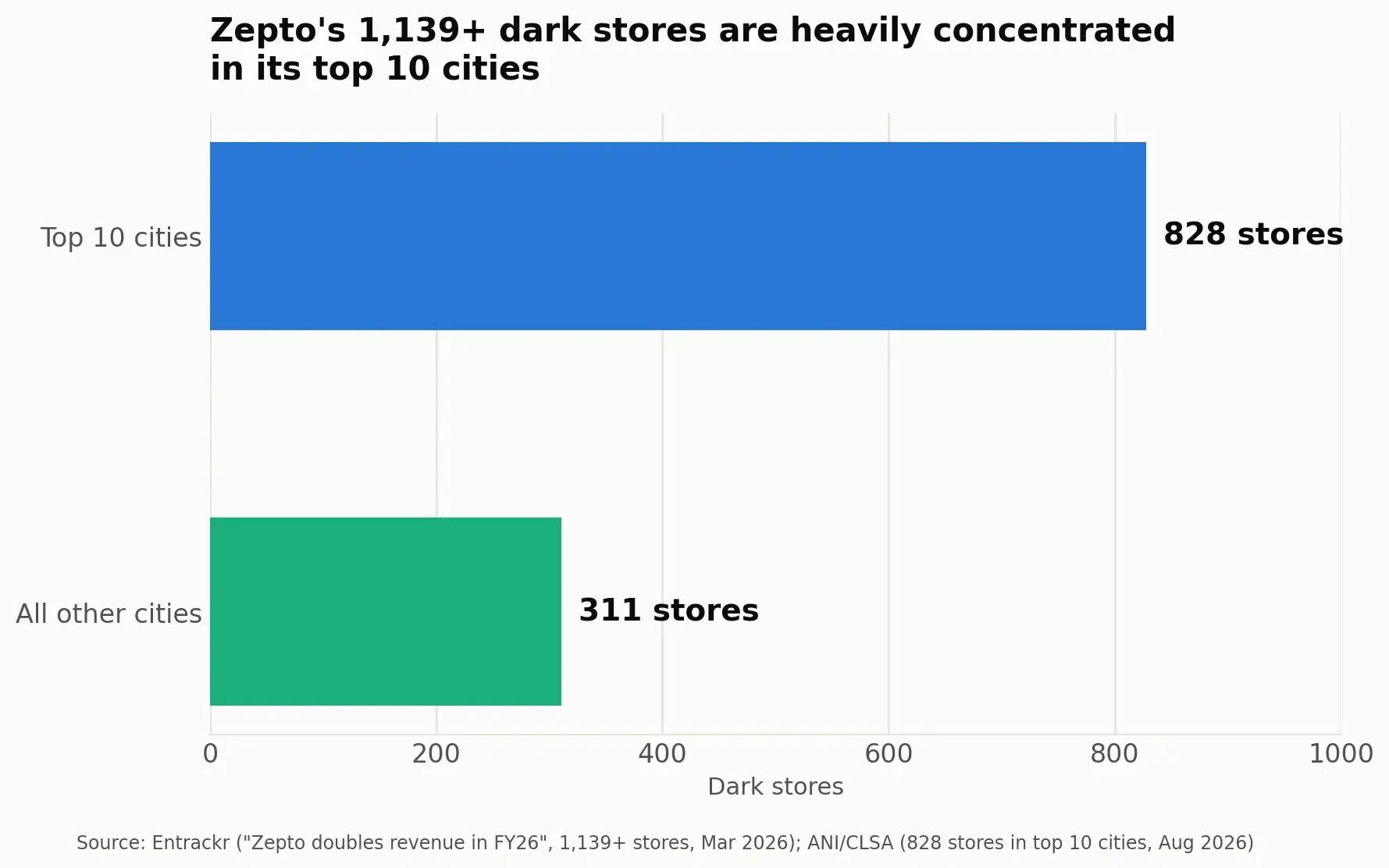
Zepto operated more than 1,139 dark stores nationally as of March 2026, fulfilling over 1.75 million orders a day.2 As of August 2026, 828 of those stores sit across just the top 10 cities — meaning a meaningful share of the remaining network is spread across smaller markets.3 That’s a real shift from a year earlier: as of July 2025, Zepto was operating 70+ cities with 900+ dark stores, and had just flagged unusually fast adoption in Tier-2 markets — Zepto’s President at the time, Vinay Dhanani, noted that Nashik crossed 1,000 daily orders within six weeks of launch, a pace that “took months” to reach in Delhi, Mumbai, or Bangalore.4 Quick commerce as a category (Blinkit, Zepto, and Instamart combined) had expanded to 477 cities nationally by August 2026, with smaller/emerging platforms leading the push into underserved geographies faster than the top three incumbents.3
The practical read for a brand: Zepto’s map isn’t just bigger than it was a year ago, it’s denser in specific pockets — and that density is what makes city- and neighbourhood-level ad targeting meaningfully different from running one national campaign.
Zepto Atom: the actual proof this targeting is real
The clearest evidence that Zepto can target (and report) at hyperlocal granularity isn’t a claim from an ad-tech vendor — it’s Zepto’s own analytics product. Zepto Atom, a subscription analytics tool launched May 15, 2025, gives brands what CEO Aadit Palicha described as “a live map of every neighbourhood and pincode they serve to derive hyperlocal insights on their performance.”5 Concretely, Atom provides pincode-by-pincode market share and brand performance data, minute-by-minute sales/impressions/conversion tracking, and share-of-voice data in search and on the homepage — a level of granularity most Indian e-commerce platforms don’t expose to brands at all.5

This matters for ad strategy specifically because it means a brand isn’t targeting “Zepto users in Mumbai” as one undifferentiated block — it can see which pincodes within Mumbai are converting, and shift ad and inventory focus accordingly.
Zepto Atom isn’t the only option — third-party tools cover this across platforms too
Atom’s one real limitation is that it’s Zepto-only, by definition — it can’t tell you how the same city or category is performing on Blinkit or Instamart in the same view. That’s the gap third-party quick-commerce analytics platforms are built to fill, and GobbleCube is a good example of what that looks like in practice. It’s an AI-powered analytics platform built for CPG/D2C brands that raised a $15 million Series A in April 2026 (led by Susquehanna Venture Capital, with InfoEdge Ventures and Kae Capital participating), and it already counts HUL, Nivea, Tata Consumer Products, ITC, and L’Oréal among its 400+ brand clients.6 Unlike Atom, it’s platform-agnostic — it’s built to work across 30+ marketplaces spanning India, MENA, and LATAM, not just one app.6
On the specific capabilities that matter for city-level ad and revenue planning, independent write-ups of the product confirm it offers city-level granularity for hyperlocal strategy and execution, and separately, keyword-level Share of Voice tracking (i.e., ad/search visibility, not just organic sales) alongside AI-assisted ad-spend and RoAS optimization tooling.7,8 In practice, that makes it a reasonable alternative — or complement — to Zepto Atom for a brand that wants one dashboard to compare city-level revenue and ad-visibility splits across Zepto, Blinkit, and other platforms at once, rather than logging into each platform’s own (and differently-shaped) native analytics tool separately.

What this means for a D2C brand’s targeting strategy
- Don’t treat “Zepto ads” as one national buy. With store density varying so much city to city — and Zepto’s own tooling built around pincode-level reporting — a flat national campaign is leaving the platform’s actual advantage on the table.
- Watch Tier-2 momentum closely. The Nashik data point (1,000 daily orders in six weeks vs. months for metros) suggests demand can ramp faster in some Tier-2 markets than in saturated metros — worth testing budget there earlier than intuition suggests, especially for categories without strong metro brand equity yet.
- Use Atom-style data before setting city-level budget splits, if you have access to it. Reallocating spend by pincode-level conversion data (where available) is a genuinely differentiated lever versus Amazon or Flipkart, where advertisers don’t get this granularity. If you’re active on multiple quick-commerce platforms, a cross-platform tool like GobbleCube can be a more efficient way to get comparable city-level splits without stitching together each platform’s own dashboard by hand.
- Budget for RoAS-optimized bidding, not manual CPC/CPM control. Since Zepto’s Sponsored Products system appears to optimize a composite bid automatically, plan campaigns around target RoAS and let the system allocate, rather than trying to hand-tune bids the way you might on a traditional CPC platform.
The bottom line
Zepto’s ad business is growing fast because advertising margins dwarf grocery margins — but the more interesting story for D2C brands is the targeting granularity that Zepto’s dark-store network makes possible almost by accident. Pincode-level data through Zepto Atom, a genuinely different (RoAS-optimized, composite-bid) auction mechanic on Sponsored Products, and a rapidly densifying but geographically uneven store network all point to the same conclusion: city-level thinking isn’t optional on this platform, it’s the whole game.
Keep reading: Increase Sales on Blinkit — for how Blinkit’s ad model compares — or The Complete D2C Growth Playbook for how quick commerce fits into your broader channel mix.
Sources
- IndMoney, “How Zepto Is Building a High-Margin Advertising Business.”
- Entrackr, “Zepto doubles revenue in FY26, losses widen to ₹5,905 Cr.”
- ANI / CLSA, “Quick commerce expands to 477 cities as players target smaller, untapped markets: CLSA,” August 2026.
- Franchise India, “Zepto to Add 150 New Dark Stores in Next Quarter, Sees Surge in Tier 2 City Demand,” July 2025.
- Inc42, “Zepto Launches Subscription-Led Analytics Tool For Consumer Brands” (Zepto Atom, launched May 15, 2025).
- Inc42, “GobbleCube Nets $15 Mn To Help Brands Scale On Digital Marketplaces.”
- MetricsCart, “5 Best Quick Commerce Monitoring Tools in India.”
- 42Signals, “GobbleCube vs 42Signals for Marketplace & Quick Commerce Insights.”
Want help building a city-level quick-commerce ad strategy for your brand? Reach out via the Contact page.
Pingback: Increase Sales on Blinkit: Proven Strategies for D2C Brands (2026)
Pingback: A Day in the Life of a Key Account Manager: Ecommerce & Quick Commerce (2026) - d2cgrowth.in