
Most Amazon shoppers never see a list of sellers. They see one price, one “Buy Now” button, and one delivery promise — and whichever seller is behind that single offer gets the sale. Amazon calls this the Featured Offer; almost everyone else still calls it the Buy Box. Either way, for a strategic seller running a real brand’s Amazon business, understanding exactly what moves it isn’t optional trivia — it’s the difference between a listing that converts and one that quietly sits unsold next to a competitor’s.
This is the tactical follow-up to our guide to the Seller vs Vendor vs Strategic Seller models. That piece covered who sells on Amazon India and under what structure. This one covers what actually happens once you’re listed: the specific, named factors Amazon says decide who wins the Featured Offer, what changed in India’s fee structure this year, and what’s changing next.

What the Buy Box actually decides
When multiple sellers list the same product (a near-certainty for any recognizable brand, whether from resellers, marketplaces, or a strategic-seller arrangement like the ones covered in our Seller vs Vendor guide), Amazon shows shoppers exactly one of those offers by default on the product page — the Featured Offer. The others are pushed to a secondary “Other Sellers on Amazon” link that a shrinking share of shoppers ever click. Amazon’s own seller guidance is direct about this: winning it is “the best way for your product to be discovered by more customers,” and it’s also the offer that most Buy-with-Prime, one-click, and cart-add actions default to.1
The mechanism is re-evaluated constantly — not once per listing, but effectively per shopper, per moment, based on live pricing and fulfillment data. That’s why two people browsing the same listing minutes apart can occasionally see different sellers featured, and why “winning the Buy Box” is really an ongoing operating discipline, not a one-time listing optimization.
The four levers Amazon says actually move it
Amazon doesn’t publish the exact weighting of its Featured Offer algorithm — no marketplace does, for the same reason search engines don’t publish their ranking formula. But Amazon’s own seller-facing guidance is specific about which levers matter, in this order of emphasis:1
- Price, all-in. Amazon’s language is that Featured Offers are “commonly at or below the lowest priced alternatives” — and it explicitly means landed price (item price plus shipping), not just the sticker price. A seller who “wins” on item price but charges extra shipping can still lose the Featured Offer to a free-shipping competitor at a nominally higher listed price.
- Delivery speed and certainty. “Offers with fast, free shipping are more likely to be featured, as are offers with delivery dates that are higher certainty” — a narrow, reliable delivery window beats a vague or wide one, independent of how fast the fastest end of that window is.
- Account health and order experience. Amazon frames this as “consistently providing customers with a great order experience” — correct items, undamaged, matching the listed condition, genuine, correctly charged. This is tracked on the Account Health dashboard in Seller Central and functions as a gate as much as a ranking factor: sustained poor performance can suppress Featured Offer eligibility regardless of price.
- Inventory availability. The blunt one: “your offer can’t become featured if your item is out of stock.” A stockout doesn’t just pause sales on that SKU — it hands the Featured Offer to whichever competitor is in stock, and that competitor doesn’t automatically lose it back once you restock.
Notably, Amazon’s own guidance is explicit that fulfillment method is not, by itself, one of the four levers: “fulfilling orders directly can be just as effective at increasing your chances of becoming the Featured Offer as fulfillment through the Amazon fulfillment network.”1 What matters is the outcome — fast, certain, reliable delivery — not which fulfillment program produced it. That matters a lot for the next section, because it means the FBA-vs-self-ship decision is really a decision about which path gets you to that outcome most affordably, not a shortcut around the algorithm.

FBA vs Easy Ship vs Self Ship: the choice that sets your starting line
Amazon India gives sellers three fulfillment paths, and each hands a different amount of the “fast, certain delivery” burden to Amazon versus the seller:
| Model | Who handles what | Prime badge | What it costs you operationally |
|---|---|---|---|
| FBA (Fulfilled by Amazon) | Amazon stores, picks, packs, ships, and handles customer service and returns | Automatic | Storage fees, pick & pack fees, weight-handling fees — but zero day-to-day packing/shipping work |
| Easy Ship | Seller packs the order; Amazon collects, delivers, tracks, and handles COD | Eligible | Your own packing labor per order; tracking-sync accuracy becomes your responsibility |
| Self Ship | Seller packs, chooses courier, generates the airway bill, and manages delivery end-to-end | Not eligible | Full operational load, but the most control and (above ~₹1,000 items) typically the lowest per-unit fee |
The Prime badge gap matters more than it might look on a fee spreadsheet: Self Ship sellers are not eligible for Prime, which removes them from Prime-filtered search and from Prime-only placements entirely — a real, if hard-to-quantify, ceiling on Self Ship’s reach even when its per-unit economics look best.2 The operational risk cuts the other way: on both Easy Ship and Self Ship, a missed or delayed tracking sync doesn’t just annoy a customer — it can directly suppress Featured Offer eligibility, since Amazon reads that as a delivery-certainty problem.2
Amazon India’s own fee schedule confirms the shape of the tradeoff.3 On a standard item, FC (fulfillment center / FBA) pick-and-pack starts at ₹17 for items up to 1kg, weight-handling starts around ₹37–₹51 depending on distance tier, and storage runs ₹50 per cubic foot per month — real, recurring costs that Easy Ship and Self Ship sellers simply don’t carry. Closing fees, which vary by fulfillment channel, illustrate the same pattern at the low end: an Easy Ship item under ₹300 can carry a closing fee as low as ₹2, versus ₹20–₹27 for the equivalent Self Ship or FC item in some categories.3 None of this makes one model universally “cheaper” — it depends heavily on product weight, category, and price point — but it’s exactly the kind of per-SKU math a strategic seller should actually run rather than defaulting to whichever model they started with.

The fee floor just dropped: what March 2026 changed
On March 16, 2026, Amazon India eliminated referral fees entirely on more than 12.5 crore products priced under ₹1,000, spanning 1,800+ categories, and cut Easy Ship fees by over 20% on products under ₹300.4 Amazon’s own framing was explicit that this wasn’t a temporary promotion: “This is not promotional. It is structural — and it benefits a vast majority of sellers and products listed on Amazon.in.”4 It followed a similar commission waiver from Flipkart, suggesting this is a genuine competitive repricing of the Indian marketplace floor, not a one-off gesture.5
Amazon’s own examples show just how large the swing is on affected items: a fashion jewelry item’s total selling fees dropped by roughly ₹224 (a 69% reduction), and an earphones example dropped by roughly ₹139 (56%).4
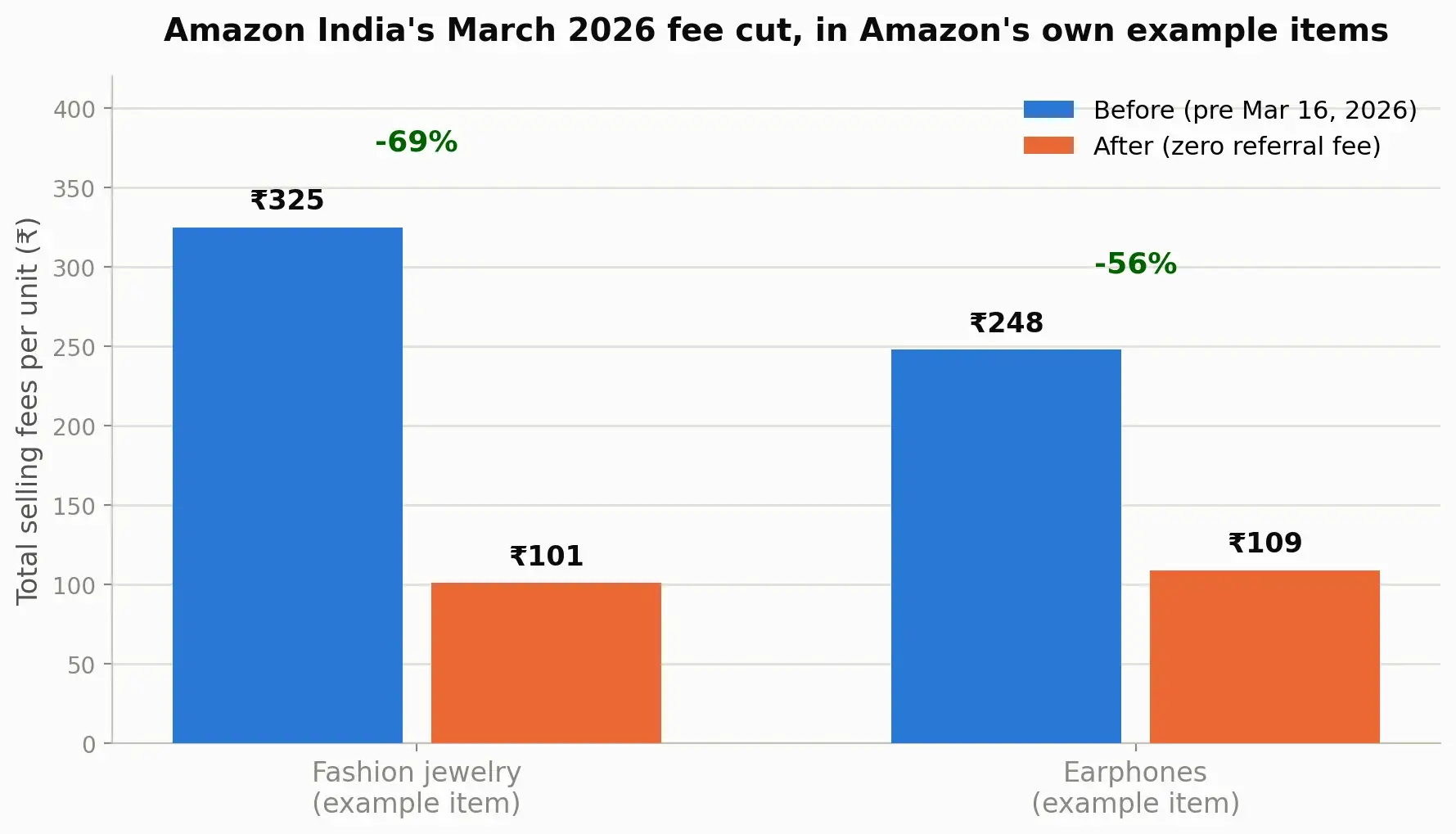
For a strategic seller, this is directly relevant to the Buy Box math above, not just a margin footnote: since landed price is the single heaviest factor in Featured Offer eligibility, a lower fee floor under ₹1,000 means more room to compete on price without cutting into margin — or, just as validly, room to hold price and bank the fee savings instead. Either way, it changes the breakeven math for every sub-₹1,000 SKU a brand has listed, and it’s worth re-running pricing on that segment specifically rather than assuming the old numbers still hold.
What’s coming next: handling time gets literal
Separately, Amazon has been tightening how precisely seller-fulfilled (FBM-style) listings must state their actual handling time, rather than defaulting to a generic estimate. The most detailed rollout of this documented so far is dated for the US marketplace on June 29, 2026: each SKU must reflect real shipping speed, either through Amazon’s own automated calculation from a seller’s shipping history, a manually set handling time per SKU, or a default based on recent confirmed shipping performance.6 Amazon’s own stated reasoning is that “more than 87% of seller-fulfilled orders in the United States already move within one day, yet many sellers still list longer handling times” — in other words, tightening the data rather than tightening the standard itself.6
The account-health numbers sellers commonly target
Amazon doesn’t publish a single official scorecard of exact Featured Offer thresholds — its own Account Health guidance is deliberately about maintaining “a great order experience” rather than hitting a magic number. That said, the following benchmarks are widely cited by seller-tooling vendors and agencies as the practical targets professional sellers operate against, and are useful as a working standard even though they’re not Amazon’s own published figures:7
| Metric | Minimum to stay eligible | Competitive target |
|---|---|---|
| Order Defect Rate (ODR) | Under 1% | Under 0.5% |
| Late Shipment Rate | Under 4% | Under 2% |
| On-Time Delivery | Above 90% | Above 97% |
| Valid Tracking Rate | — | ~99% |
| Customer Response Time | Under 24 hours | Same-day |
ODR in particular is worth understanding precisely: it isn’t one metric but a composite — negative feedback, A-to-Z Guarantee claims, and chargebacks all roll into the same number.7 That means a small number of badly handled orders can move it disproportionately, which is exactly why Amazon treats sustained account health as closer to a gate than a scoring input for the Featured Offer.
The bottom line
Winning the Buy Box in India in 2026 comes down to the same four things Amazon has always named — landed price, delivery speed and certainty, account health, and staying in stock — but the numbers underneath all four just moved. The March 2026 fee change genuinely lowers the price floor on sub-₹1,000 items, seller-fulfilled handling times are heading toward stricter accuracy, and the FBA/Easy Ship/Self Ship tradeoff is worth re-running per SKU rather than assuming. None of this is a hack; it’s operating discipline, applied consistently, on factors Amazon has been transparent about for years.
Keep reading: Seller vs Vendor vs Strategic Seller Model on Amazon — for the ownership structures behind who you’re actually competing against for this Buy Box — or The Complete D2C Growth Playbook for how Amazon fits into a broader channel strategy.
Sources
- Amazon Sell Blog, “Maximize Your Sales Potential with the Amazon Featured Offer (formerly Buy Box).”
- Shipway, “Amazon Easy Ship vs Self Ship vs Amazon FBA India: 2026 Guide.”
- Amazon Seller (India), “Fees and pricing,” official fee schedule.
- About Amazon India, “Amazon India expands zero referral fees to 12.5 crore products across 1,800+ categories,” March 2026.
- YourStory, “After Flipkart, Amazon India expands zero referral fees.”
- EcomCrew, “Amazon Tightens Handling Time Rules for Seller-Fulfilled Listings.”
- Feedvisor, “Amazon Buy Box: How to Win the Featured Offer (2026).”
Want help auditing your fulfillment mix or pricing against the new fee floor? Reach out via the Contact page.