
If you sell on Flipkart, you already know the festive season isn’t a single event — it’s a campaign. Brands and sellers spend August and September building stock plans, locking promotional budgets, and negotiating bank-offer slots for a stretch that India’s e-commerce industry now treats as make-or-break for the entire fiscal year.
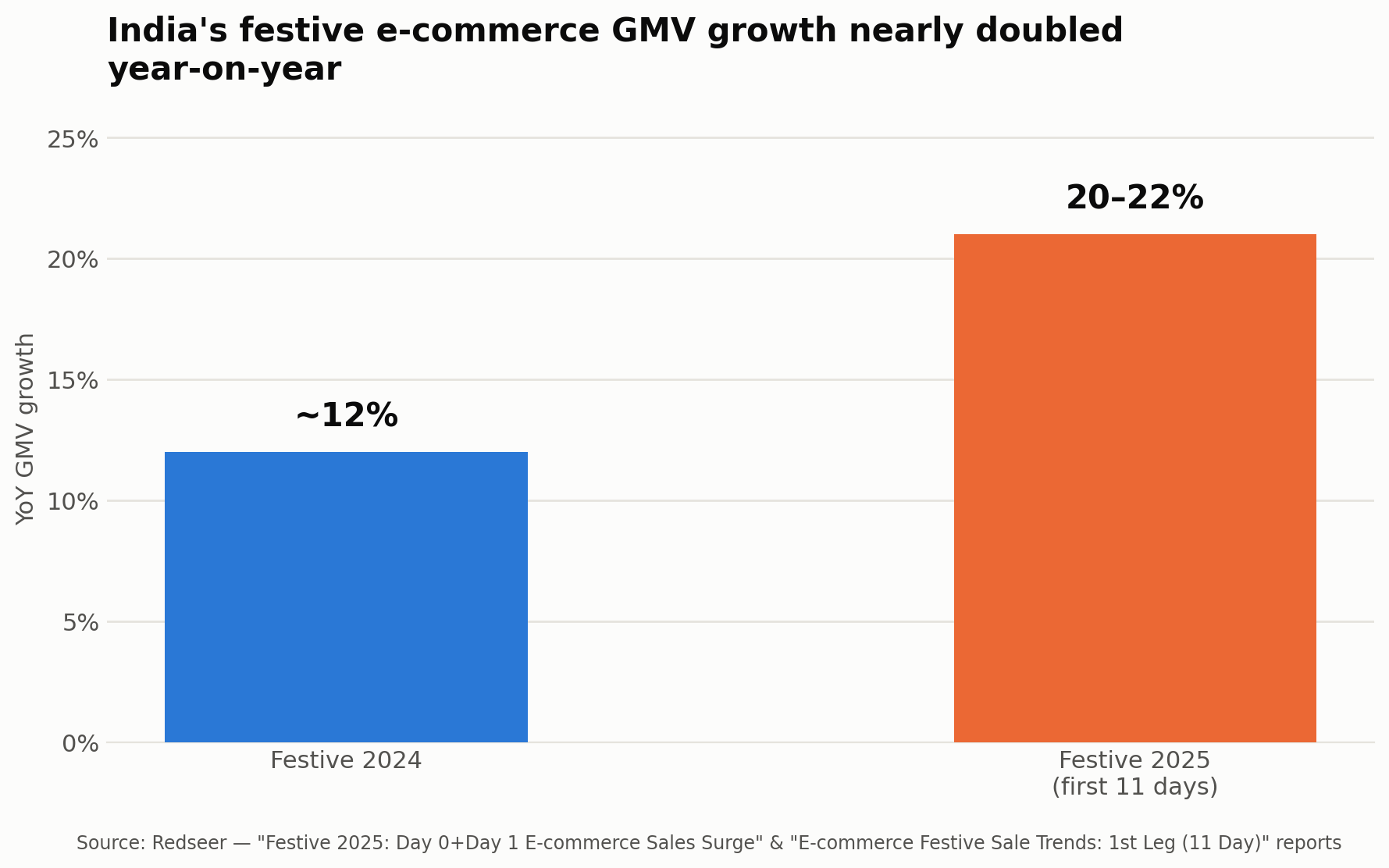
That stretch runs roughly 45 days across October and November — “O+N” in seller shorthand — and in 2025 it generated an estimated ₹1.15 lakh crore (~$13 billion) in e-commerce GMV, the best festive period the industry has seen in five years, according to research firm Redseer.1 The first 11 days alone crossed ₹60,000–62,000 crore, growing 20–22% year-on-year — nearly double the ~12% growth rate the same window posted in 2024.2
That acceleration is the first number worth sitting with.
But the headline growth number hides the part that actually matters for planning: O+N is not one sale with one audience and one hero category. It’s a sequence of phases, and Flipkart’s promotional focus — and the customer showing up to shop — changes meaningfully from one phase to the next.
The five-phase calendar
Sellers who plan O+N well tend to describe it the same way: not as “the festive sale,” but as five distinct windows, each with its own inventory, pricing, and budget posture.
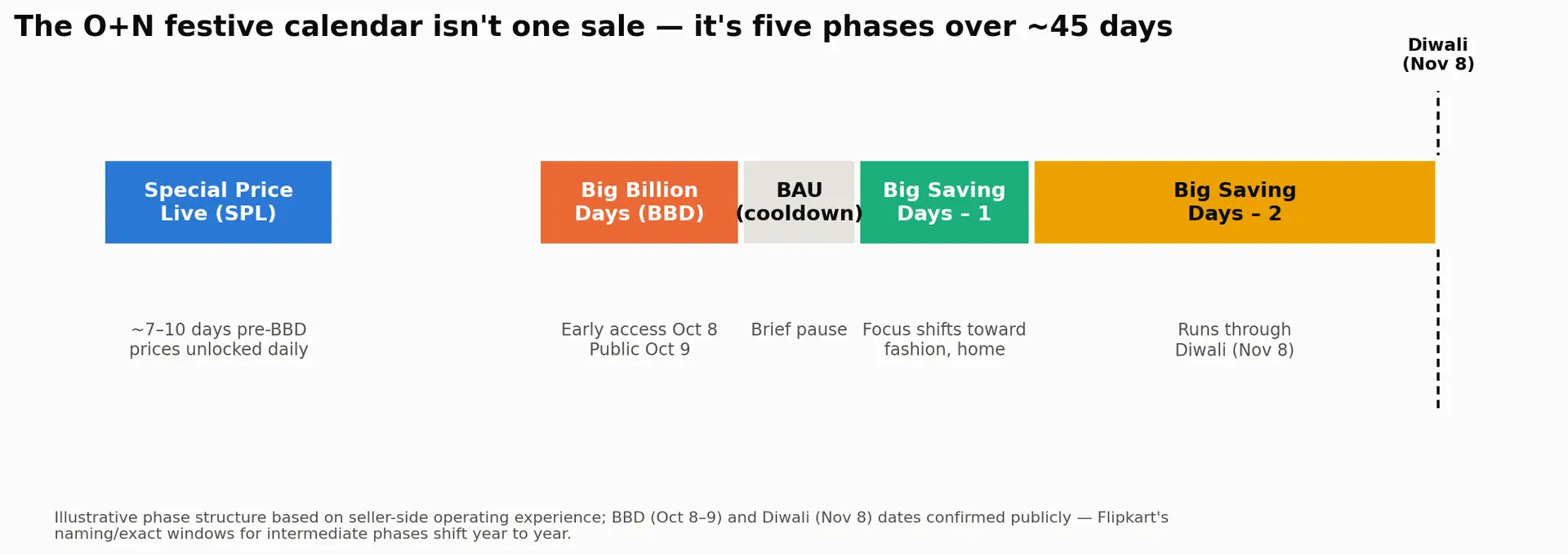
1. SPL — Special Price Live (roughly 7–10 days pre-BBD). Flipkart unlocks Big Billion Days pricing early on a rolling basis — a handful of products each day — so shoppers (and competitors) get a preview before the sale formally opens. This is a deliberate demand-priming mechanic: it lets Flipkart test price elasticity and builds search/wishlist activity ahead of Day 1.
2. BBD — Big Billion Days. The marquee event. For 2026, Flipkart has confirmed early access on October 8 for Plus, Black, and credit-card members, with the sale opening to the public on October 9.3 Notably, Amazon’s Great Indian Festival also launches on October 8 this year — continuing the now-familiar pattern of the two platforms clashing their flagship sale dates rather than staggering them, as they also did in 2021, 2022, 2024, and 2025.4,5
3. A short BAU cooldown. Public data on this gap is thin, but the 2025 precedent shows Flipkart moving almost immediately into the next event rather than leaving a long dead zone — Big Billion Days 2025 ended October 2, and Flipkart’s next branded sale opened October 4.6,7
4. Big Saving Days – 1 (the first post-BBD event). In 2025 this ran as the “Big Shopping Utsav” / “Big Festive Dhamaka” sale, October 4–8, sitting between BBD and Diwali.7
5. Big Saving Days – 2, running through Diwali. In 2025, Flipkart’s “Big Diwali Sale” picked up around October 10 and carried through to Diwali itself (October 20, 2025). Diwali in 2026 falls on November 8, which is what stretches this year’s back half of the calendar out further than 2025’s.
Where the category focus shifts — and one correction worth making
The seller-side read on this — electronics, mobiles, and large/small appliances dominating SPL and BBD, rotating to fashion, home, and decor by the Big Saving Days phases — is mostly backed by the public data. But there’s one nuance worth flagging before setting budgets by it.

The BBD-heavy end is well supported. In the first 11 days of festive 2025, smartphones and appliances alone contributed 60–65% of total GMV and grew 18–20% — the two clear demand engines. Fashion, by contrast, posted only “low single-digit growth” in that same window despite historically being a festive driver, and GST-linked price cuts (TVs above 32″ dropped from 28% to 18% GST; large appliances got similar relief) gave electronics and appliances an extra tailwind that fashion didn’t get until later.2,8
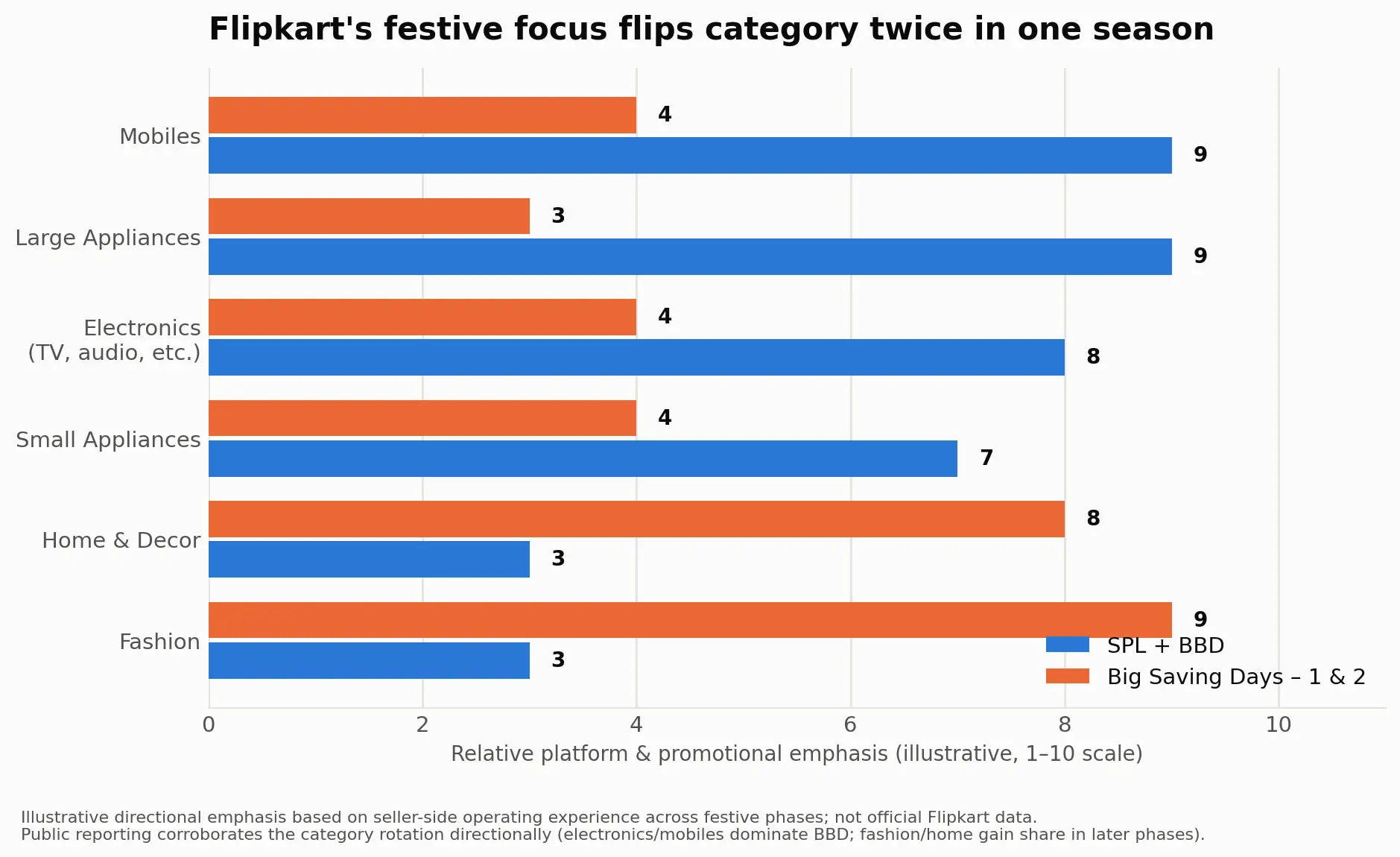
The nuance: looking at what Flipkart actually promoted in the first post-BBD sale in 2025 (commonly shorthanded as BSD-1 — publicly branded “Big Shopping Utsav”), the deal mix was still electronics- and mobile-heavy — iPhone 16, Galaxy S24 series, and “large appliances & electronics” were the headline categories, not fashion.7 The clearer rotation toward fashion, home, and decor shows up in the data as a second-phase and Diwali-adjacent phenomenon — closer to what’s labeled BSD-2 here — helped along by the GST cut on apparel to 5%, which Redseer specifically flagged as pulling furniture and mid-market apparel (₹1,000–2,500) off wishlists and into carts as the season progressed.2
So the practical takeaway: if a brand is splitting promotional and stocking budget on the assumption that fashion/home gets meaningful lift as early as BSD-1, the 2025 evidence suggests that lift is more reliably a BSD-2/Diwali-approach phenomenon, with BSD-1 still functioning as a second bite at the electronics/mobile apple. It’s worth stress-testing this against a category’s own sell-through data before committing spend to an earlier fashion push than the platform itself seems to be making.
One structural note: SPL, BSD-1, and BSD-2 are accurate as operator/seller-side shorthand for this phase structure, but they aren’t Flipkart’s own public consumer-facing branding — the company has used different names for these windows each year (2025: Big Billion Days → Big Shopping Utsav/Big Festive Dhamaka → Big Diwali Sale). Useful for internal planning; just not what a shopper sees on the app.
Why this matters for budget planning
Redseer’s data points to three planning implications that fall directly out of the phase structure above.
- Front-load electronics/mobile inventory and bidding, not spread it evenly. With 60–65% of the first-leg GMV concentrated in smartphones and appliances, a brand in that category that under-invests in SPL/BBD readiness is leaving the majority of the addressable festive pool on the table before the fashion-heavy phases even open.
- Don’t assume Tier-1 is where the volume is. 60–65% of festive shoppers in 2025 came from Tier 2+ cities2 — a detail that should inform both creative (vernacular, value-forward messaging) and logistics/COD readiness, not just metro-first campaigns.
- The same-day launch with Amazon still changes the bidding dynamic, even though it’s not new. Flipkart and Amazon have clashed their flagship sale dates in most recent years (2021, 2022, 2024, 2025) rather than staggering them, and 2026 continues that pattern with both opening October 8. Category-level ad inventory (search, display, app placements) across both marketplaces gets more contested on that single day than it would if the launches were staggered.4,5 Both platforms run CPC (cost-per-click) auctions, not CPM — so the practical effect for brands selling on both is a higher cost-per-click on Oct 8–9, not a gradual ramp.
The bottom line
O+N isn’t a single 45-day sprint — it’s five sprints back to back, each rewarding a different category, a different customer, and a different bidding strategy. Brands that treat BBD readiness and Diwali-phase readiness as the same problem tend to either overspend chasing electronics traffic in a fashion-favoring window, or under-stock fashion/home right when the data says the demand curve is actually bending their way. Plan the calendar in phases, and let last year’s public data — not just this year’s assumptions — set the category split.
Keep reading
- The Complete D2C Growth Playbook for Indian Startups: From Launch to Scale (2026) — the channel-mix framework this festive calendar plugs into.
- Seller vs Vendor vs Strategic Seller Model on Amazon — if you’re running the same festive playbook on Amazon alongside Flipkart.
Sources
- Redseer, “Redseer Forecasts The Best Festive Period for E-commerce in the Last 5 Years, GMV to cross 1.15 Trillion”, Business Standard, September 2025.
- Redseer, “E-commerce Festive Sale Trends: 1st leg (11 day) closes at INR 60K to 62K Crore, up by 20% to 22%”.
- PCQuest, “Flipkart Big Billion Days 2026 Sale starts October 9: All details”.
- TechRadar, “Clash of titans: Amazon, Flipkart change their mega festival sale to the same date”.
- About Amazon India, “When is Amazon Great Indian Festival 2026? Dates revealed”.
- Zingoy, “Flipkart Big Billion Days (BBD) End Date Revealed! Next Sale after Big Billion Days”.
- Desidime, “Flipkart Big Shopping Utsav Festive Sale 2025 Dates, Bank Offers & more”.
- Redseer, “Festive 2025: Day 0+Day 1 E-commerce Sales Surge 25% with GST Boost, demand led by Smartphones and TVs”.
Note: SPL, BSD-1, and BSD-2 are used throughout this article as seller/operator shorthand for Flipkart’s internal phase structure; they are not Flipkart’s official public sale names, which vary year to year (see note above).
Pingback: Seller vs Vendor vs Strategic Seller Model on Amazon: A Complete Guide for Brands - d2cgrowth.in