
Open Blinkit, Zepto or Swiggy Instamart on Diwali weekend and you don’t see a grocery app. You see a festive storefront that was planned weeks earlier: sponsors in the header, the store sorted by festive jobs, ₹79 hooks, gift shops, games and paid slots in search. None of it is random. Each move uses a well-studied idea from consumer psychology.
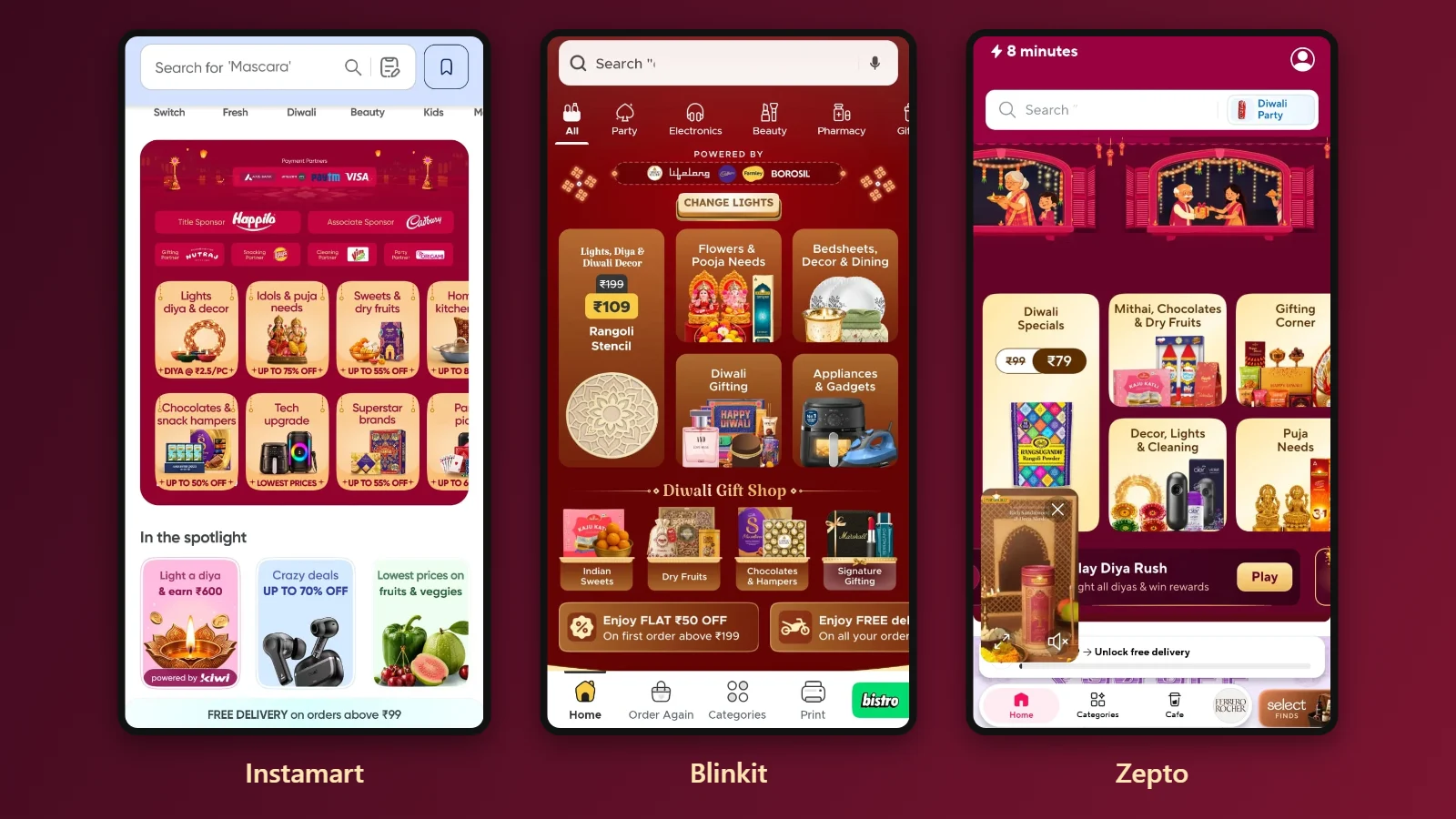
This post breaks down seven moves the three apps made this Diwali, explains how the deals behind them are put together, and names the psychology concept behind each one, with the original research, so you can use the same ideas in your own plans. If you want the operational side (stock, listings and ad budgets), read our Diwali 2026 quick-commerce playbook first.
1. The storefront was sold weeks in advance, as part of a media plan
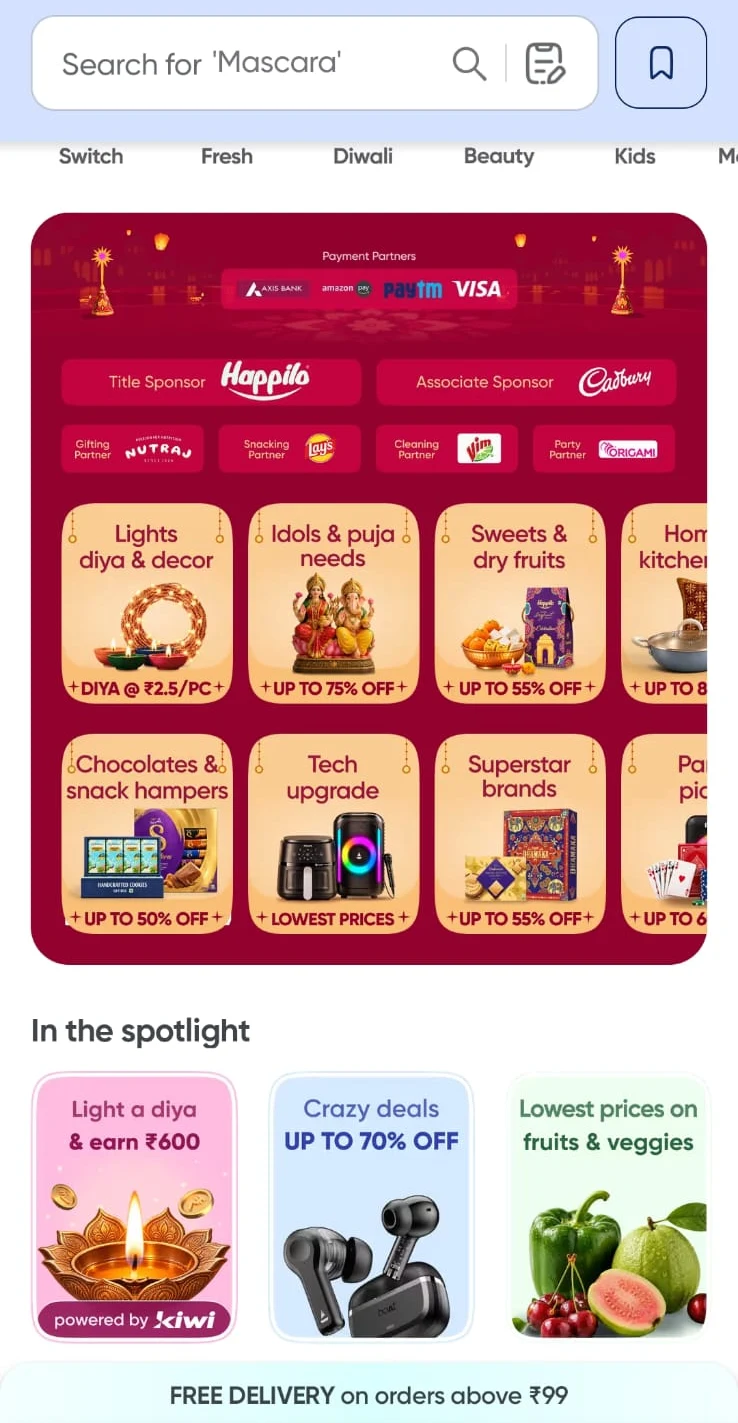
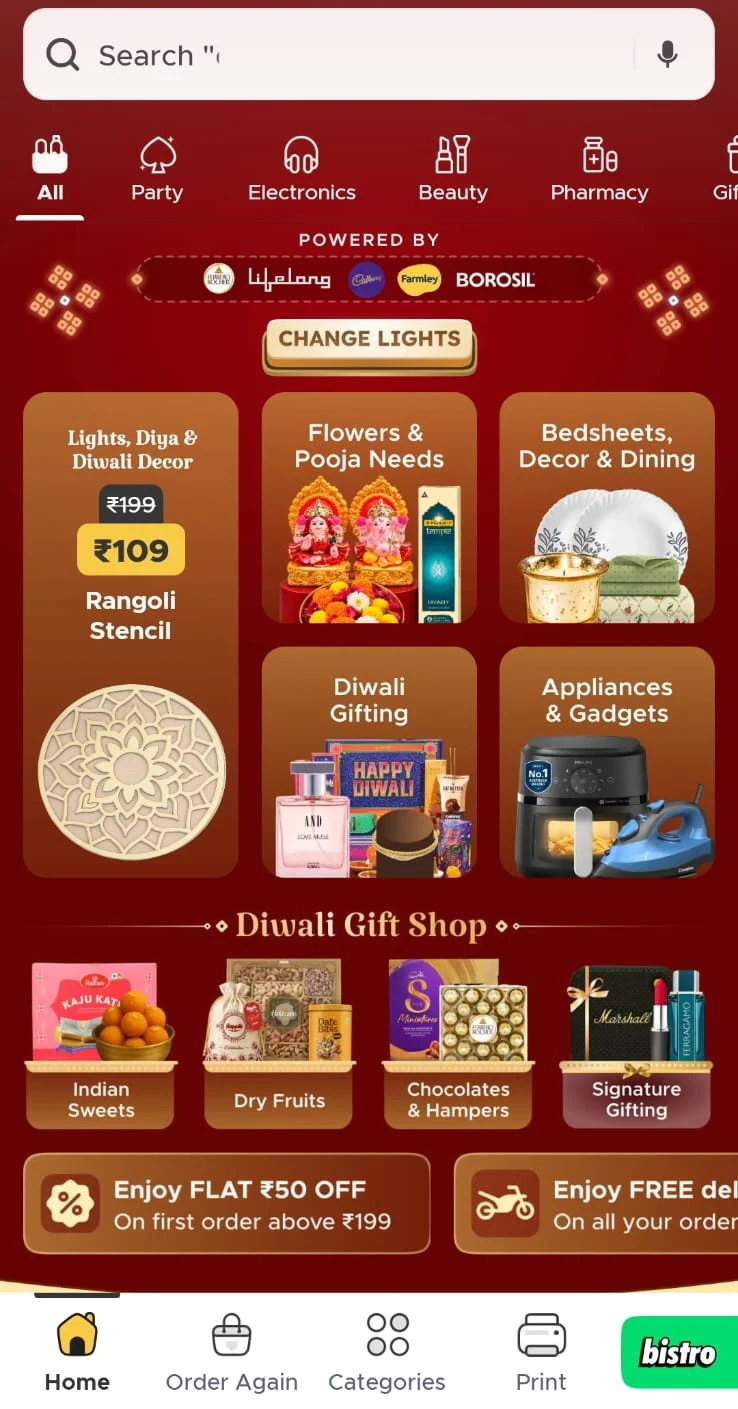
Instamart’s Diwali tab had a full sponsor ladder, like a cricket league. Happilo was the Title Sponsor and Cadbury the Associate Sponsor. Below them sat one partner per category: Nutraj (gifting), Lay’s (snacking), Vim (cleaning) and Origami (party), plus four payment partners: Axis Bank, Amazon Pay, Paytm and Visa. Blinkit’s Diwali homepage was “Powered by” Ferrero Rocher, Lifelong, Cadbury, Farmley and Borosil.
What a shopper sees as a logo strip is only one line in a brand’s festive media plan. In practice, the plan is built like this:
- Homepage sponsorship buys the brand’s name and logo at the top of the festive storefront.
- Category sponsorship comes with it. When a shopper opens a category, such as sweets and dry fruits, several of the sponsor’s SKUs are boosted to the top of that page, where they collect the most impressions.
- Impressions convert on this channel. Quick commerce is a high-intent channel: people open the app to buy something in the next few minutes, not to browse. So delivering a high number of impressions translates into sales, and that is how the platform sells these packages and closes the brand’s inventory within the plan.
- It is all locked 40–50 days ahead. The inventory a brand will need, which products get placed where on the app, and even the wireframe of the festive app (which tiles appear, in what order and for which brand) are decided well before the festival. For Diwali on November 8, that means the plan was closed by late September.
The money behind this is growing fast. According to the Pitch Madison Advertising Report 2026, quick-commerce ad spend in India rose from ₹300 crore in 2023 to ₹1,325 crore in 2024 and ₹4,000 crore in 2025, with ₹6,000 crore forecast for 2026 (The Media Ant).
The psychology: the mere-exposure effect. People tend to like things more simply because they have seen them more often. Psychologist Robert Zajonc showed this in 1968 with made-up words and unfamiliar symbols: the more often participants saw one, the more positively they rated it, even though it meant nothing (Zajonc, 1968). A sponsor whose logo sits on the header and whose packs sit at the top of every relevant category is building that familiarity at the exact moment the shopper is choosing.
What brands can copy: treat festive quick commerce as a media plan, not a last-minute ad budget. Start the conversation with your platform account manager at least two months before the festival, decide which SKUs you want boosted in which categories, and make sure the stock for those SKUs is planned before the placements are confirmed. A boosted SKU that goes out of stock wastes the impressions you paid for.
2. Aisles were replaced by festive missions
None of the apps led with “Snacks” or “Dairy”. They led with the jobs a household has to get done before the puja:
| App | Diwali tiles on the homepage |
|---|---|
| Blinkit | Lights, Diya & Diwali Decor · Flowers & Pooja Needs · Bedsheets, Decor & Dining · Diwali Gifting · Appliances & Gadgets · Diwali Gift Shop |
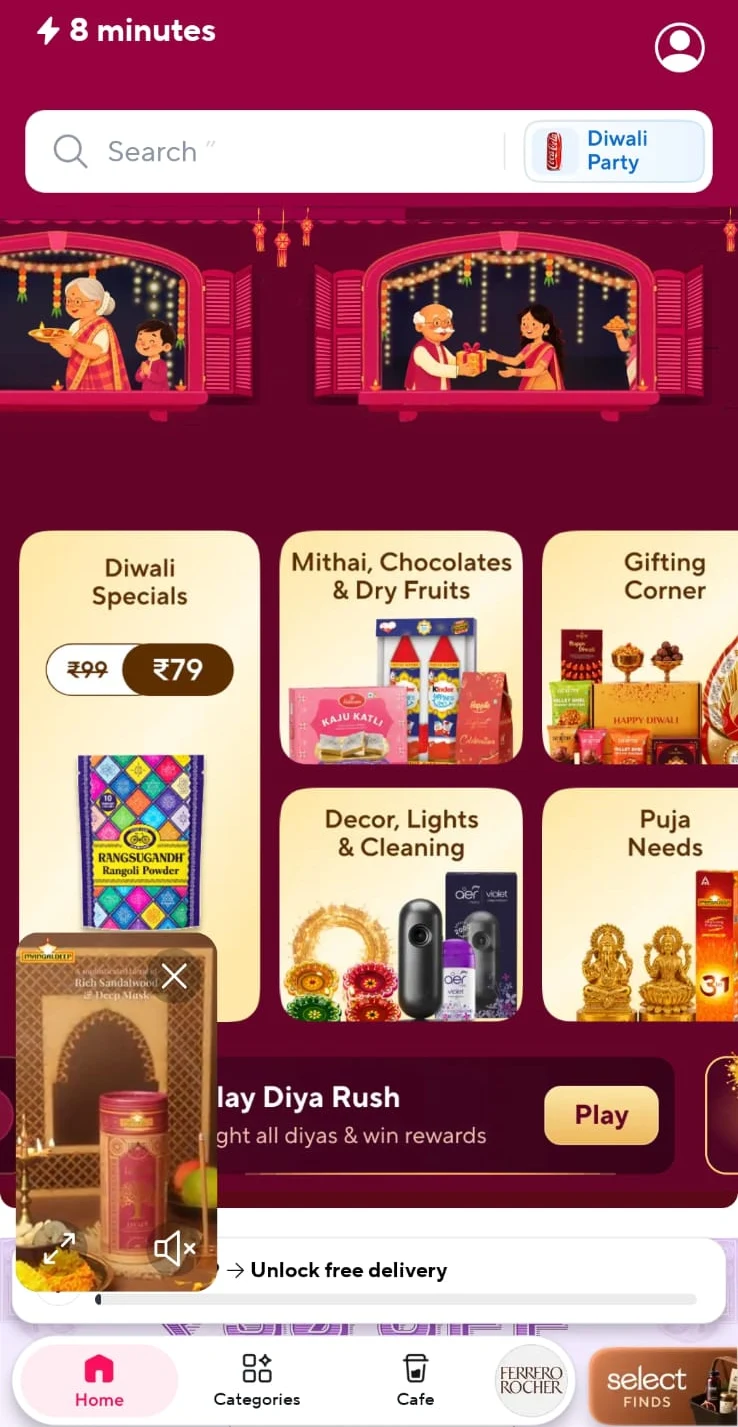
| Zepto | Diwali Specials · Mithai, Chocolates & Dry Fruits · Gifting Corner · Decor, Lights & Cleaning · Puja Needs |
| Instamart | Lights, diya & decor · Idols & puja needs · Sweets & dry fruits · Chocolates & snack hampers · Tech upgrade · Superstar brands |
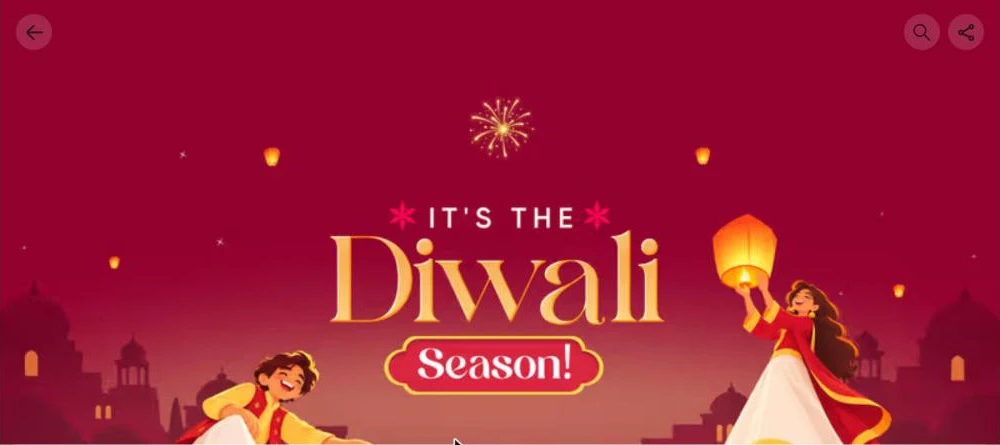
Each tile opens a small, curated store. Instamart’s “It’s the Diwali Season” store split lighting alone into Lights, Diyas, Lanterns, Candles, Lamps, Bulbs and Tubelights.
The psychology: choice overload and choice architecture. Too many options can make people less likely to buy. In a well-known supermarket study, shoppers who were offered 6 jams were about ten times more likely to buy than those offered 24 (Iyengar and Lepper, 2000, via APA). Later research shows the effect depends on the situation, but the lesson for a festive app holds: a small, curated set organised around a clear goal (“puja needs”) is easier to buy from than a catalogue of 30,000 products. Designing how choices are presented is what behavioural economists call choice architecture.
What brands can copy: get your festive SKUs mapped into these mission collections, not just your usual category. A cleaning brand belongs in “Decor, Lights & Cleaning” in the week before Diwali; a cookware brand in “Bedsheets, Decor & Dining”. Use the mission’s words in your titles (“for puja”, “Diwali gift box”).
3. Price anchors and a free-delivery finish line
Every app opened the basket with a very cheap festive item shown against a higher crossed-out price:
- Instamart: “Diya @ ₹2.5/pc”, with “up to 75% off” on idols and puja needs.
- Blinkit: a rangoli stencil cut from ₹199 to ₹109.
- Zepto: rangoli powder cut from ₹99 to ₹79 as its “Diwali Specials” lead.
Then each app gave the shopper a target. Instamart showed free delivery on orders above ₹99. Zepto put an “Unlock free delivery” progress bar at the bottom of the screen. Blinkit offered flat ₹50 off a first order above ₹199.
The psychology: anchoring. The first number we see becomes a reference point for judging the next one. Amos Tversky and Daniel Kahneman showed that even an obviously random number shifted people’s estimates towards it (Tversky and Kahneman, 1974). A crossed-out ₹199 makes ₹109 feel like a win before the shopper has asked whether ₹109 is a fair price.
The psychology: the goal-gradient effect and the power of “free”. People speed up as they get closer to a goal. In a café loyalty study, customers bought coffee more often as they neared a free drink, and customers given a card with two bonus stamps already filled in finished faster than those starting from zero (Kivetz, Urminsky and Zheng, 2006). And “free” is treated differently from a low price: when one of two chocolates in an experiment became free, far more people chose it, even though the price gap between the two stayed the same (Shampanier, Mazar and Ariely, 2007). A progress bar towards free delivery combines both.
The thresholds sit right where Indian quick-commerce baskets already are. In a LocalCircles survey published on October 27, 2026, 69% of quick-commerce users said they spend ₹200–999 per order, and 43% said they don’t want to pay any extra fee (The Wire / LocalCircles). A shopper ₹40 short of free delivery will add a ₹49 item.
What brands can copy: have an honest entry SKU at ₹49–149 that’s useful for the festival, and a pack size that helps a basket cross the free-delivery line. Anchors work, but only if the reference price is real. In its Lights store, Instamart showed one brand of LED string lights listing most of its range at 50–95% off MRP; when an MRP looks inflated, the anchor stops working and trust drops.
4. A gift shop at every price point
Gifting got its own storefront on all three apps. Blinkit’s “Diwali Gift Shop” was split into Indian Sweets, Dry Fruits, Chocolates & Hampers and Signature Gifting, the last showing perfumes and a Marshall speaker. Zepto had a “Gifting Corner”, and Instamart a “Chocolates & snack hampers” tile.
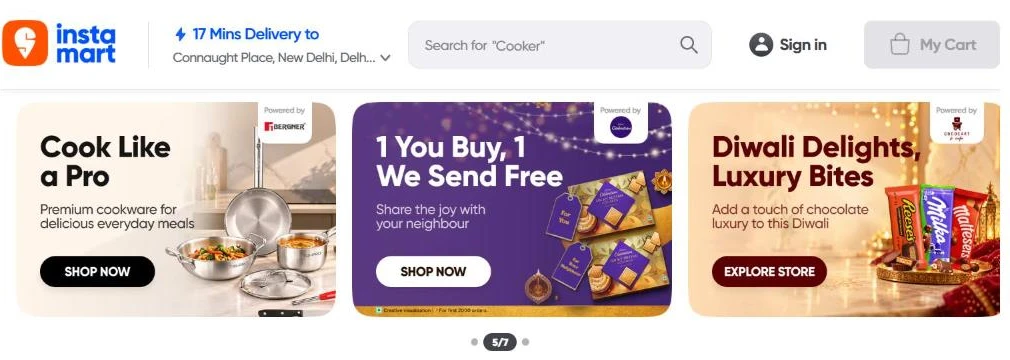
On Blinkit’s website, the results for “gift hamper” were full of festive editions of everyday products: a Kinder Joy Diwali gift pack, an Aashirvaad Whole Spices Diwali Gift Box, a Toblerone “Happy Diwali” pack, an Appy Fizz can gift pack and a festive Real juice pack. Instamart’s website also ran a “1 You Buy, 1 We Send Free” offer that sent a second box to the buyer’s neighbour, for the first 2,000 orders.
The psychology: mental accounting. Richard Thaler showed that people don’t treat all money as interchangeable. They put it into mental “accounts” with their own budgets and rules (The Decision Lab). Diwali has its own account: in an InMobi survey of 1,110 consumers in August 2026, 77% said they had increased their festive budgets (The Media Ant). A ₹969 spice box that would never be bought from the grocery budget is easy to justify from the gifting budget. Put a staple in a gift box and you move it into a different, more generous account.
The psychology: reciprocity. We feel obliged to return a favour. Robert Cialdini lists it as one of the core principles of persuasion (Influence at Work). The “send one to your neighbour” offer uses it twice: the buyer gets to give a gift at no cost, and the neighbour receives the brand from someone they know, which is a warmer introduction than any ad.
What brands can copy: a festive edition doesn’t have to be a hamper. Put your best-selling product in a gift-ready box at a clear price and list it as a separate SKU with “Diwali gift” in the title. That makes it eligible for the gift shop, the gifting tiles and gift searches, and moves it into the shopper’s gifting budget.
5. Games to keep people on the app
All three apps added something to play with:
- Zepto: “Diya Rush”, a game where you light all the diyas to win rewards.
- Instamart: “Light a diya & earn ₹600”, powered by the fintech app Kiwi.
- Blinkit: a “Change lights” button in the middle of its festive homepage.
The psychology: variable rewards. Rewards that are uncertain keep people engaged longer than predictable ones. The idea goes back to B.F. Skinner’s work on reward schedules and is a core part of Nir Eyal’s “Hooked” model of habit-forming products (Farnam Street on Hooked). A game with a prize you might win keeps the shopper on the homepage longer, and every extra second means more sponsor impressions and another chance to add an item.
What brands can copy: the Instamart example shows who pays: a payments brand funded the reward to reach festive shoppers. Ask your platform whether you can co-fund an in-app game or reward. It is often a less crowded way onto the homepage than a banner.
6. Search became a shelf you rent
Search is where intent is highest, and the apps monetised it from the first keystroke. Zepto placed a “Diwali Party” chip with a Coca-Cola can inside its search bar. On Blinkit’s website, typing “diwali” brought up suggestions for lights, gifts, gift packs and decoration, and the first row of results included sponsored tiles marked “Ad”: an Amul Gulab Jamun tin and an Amazon Pay gift card. Zepto also ran a floating, auto-playing Mangaldeep video ad and a Ferrero Rocher icon in its bottom navigation bar.
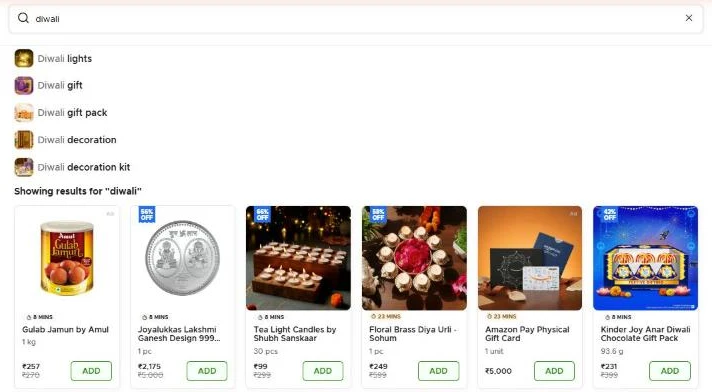
The psychology: position bias. People trust and click whatever is shown first. In an eye-tracking study of Google users, researchers secretly swapped the order of the results, and people still clicked the top result more often, even when it was the less relevant one (Pan et al., 2007, “In Google We Trust”). On a small phone screen with a shopper in a hurry, the first row of results is the shelf at eye level.
What brands can copy: bid on the event words people type (“diwali”, “diwali gift”, “gift hamper”, “diya”, “rangoli”), not just your category, and protect your brand name so a rival can’t take the top slot when someone searches for you. Our Zepto Ads guide explains how to limit that spend to the cities and pincodes where you have stock.
7. “High demand”, “first 2,000 orders” and stretched delivery times
At the peak, the apps signalled demand rather than hiding it. Blinkit’s app showed a 31-minute delivery time with a “High demand” tag. Instamart’s neighbour offer was limited to the first 2,000 orders. Delivery promises stretched: Blinkit’s website showed some items at 8 minutes and others at 23 in the same search, Zepto showed 24 minutes on its website, and Instamart 17. Nobody stopped taking orders.
The psychology: scarcity and social proof. We value things more when they seem limited, and we read other people’s demand as a signal of quality. In a 1975 study, people rated cookies from a jar holding 2 cookies as more desirable than identical cookies from a jar of 10, and liked them most when the jar had just gone from 10 to 2 (Worchel, Lee and Adewole, 1975). Cialdini lists scarcity and social proof among his principles of persuasion. A “High demand” tag does both at once: everyone is ordering, so order now.
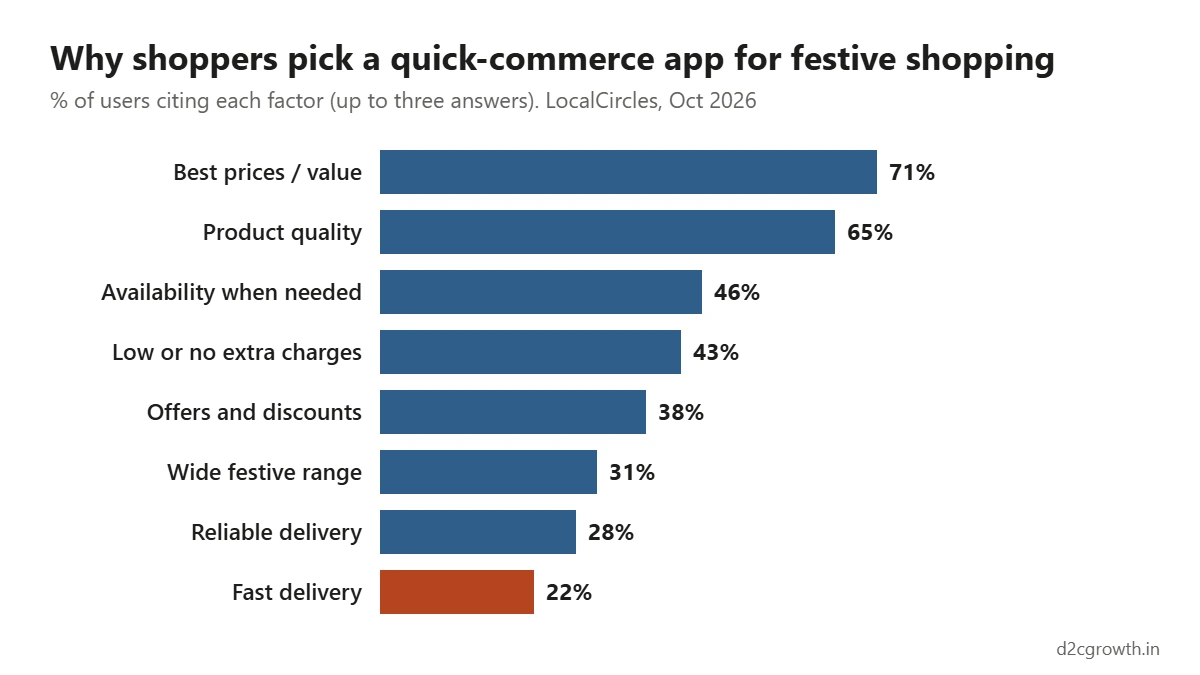
Shoppers seem to accept slower delivery on a festive day. Only 22% of LocalCircles respondents named fast delivery as a reason to choose a platform for festive shopping, the lowest of all the factors.
What brands can copy: genuine limits work (“first 500 orders”, “festive edition”). But on a peak day the shopper buys what the nearest store has, so availability at dark-store level matters more than any urgency message.
Use these ideas honestly
Every concept above can be pushed too far. India’s Guidelines for Prevention and Regulation of Dark Patterns, issued by the Central Consumer Protection Authority in November 2023, list practices such as false urgency, basket sneaking and drip pricing as dark patterns (JSA). A fake “only 2 left”, an inflated MRP or a fee revealed at checkout may lift one order, but it costs trust, and the LocalCircles data shows that value (71%) and quality (65%) are what bring festive shoppers back.
The numbers behind the apps
| Data point | Figure | Source |
|---|---|---|
| Preferred app for last-minute festive shopping | Amazon Now 22%, Blinkit 19%, Zepto 14%, BigBasket 12%, Instamart 9%, Flipkart Minutes 8% | LocalCircles, Oct 2026 |
| Quick-commerce orders of ₹200–999 | 69% of users | LocalCircles, Oct 2026 |
| Quick-commerce ad spend in India | ₹4,000 crore in 2025; ₹6,000 crore forecast for 2026 | Pitch Madison Advertising Report 2026, via The Media Ant |
| Festive shopping window | 60% planned to buy within the month before festivals; 29% within a week | InMobi survey, Aug 2026, via The Media Ant |
| Blinkit dark stores and monthly users | 2,750+ stores; about 5.8 crore monthly active users, up 53% year on year | UNI, citing Bank of America and Sensor Tower, Oct 2026 |
| Average order value (Q4 FY26) | Instamart about ₹700, Blinkit about ₹665 | Inc42, Aug 2026 |
| Last year’s peak (Diwali 2025) | Zepto delivered more than 2 million orders a day around Diwali | Business Standard, Oct 2025 |
The cheat sheet: platform move, psychology, brand action
| Platform move | Psychology concept | What a brand should do |
|---|---|---|
| Homepage and category sponsorships with boosted SKUs | Mere-exposure effect | Lock the festive media plan, SKUs and stock 40–50 days ahead |
| Festive mission tiles and curated stores | Choice overload, choice architecture | Map SKUs into mission collections; use mission words in titles |
| Crossed-out prices and ₹79 hooks | Anchoring | An honest entry SKU at ₹49–149 with a real reference price |
| Free-delivery progress bars | Goal-gradient effect, zero-price effect | Pack sizes that help a basket cross the threshold |
| Gift shops and festive editions | Mental accounting | A gift-boxed version of your best seller as its own SKU |
| “Send one to your neighbour” | Reciprocity | Fund a mechanic that turns a buyer into a gifter |
| Diya games and rewards | Variable rewards | Co-fund an in-app game or reward |
| Sponsored search tiles | Position bias | Bid on event keywords; protect your brand name |
| “High demand” and “first 2,000 orders” | Scarcity, social proof | Use only genuine limits; keep stock in the right dark stores |
Your account manager on each platform controls most of these levers, from collection mapping to sponsorship slots. Our guide to the key account manager role explains what to ask them for.
What comes after Diwali
The same playbook repeats before next Diwali. Bhai Dooj (November 10) is a smaller gifting peak, the wedding season brings gifting and beauty demand, and Christmas and New Year bring back the “Party” tabs that Blinkit and Zepto already showed on their Diwali screens. With plans locked 40–50 days ahead, the time to plan for the New Year party season is now.
The bottom line
On Diwali 2026, the quick-commerce apps did not just deliver what people planned to buy. They sold their storefronts weeks in advance as part of brands’ media plans, sorted the store by festive task, used price anchors and free-delivery finish lines to grow baskets, moved staples into the gifting budget, added games, rented out search and signalled demand. Each move rests on a well-tested idea about how people buy. A brand that understands those ideas can plan its next festive peak around them, honestly, and with stock in the right dark stores.
Keep reading
- Diwali 2026 on Blinkit, Zepto and Instamart: The Quick-Commerce Playbook for D2C Brands
- How to Increase Sales on Blinkit: Complete Guide for D2C Brands (2026)
- Zepto Ads: Why City-Level and Pincode-Level Targeting Is the Real Story
- A Day in the Life of a Key Account Manager (E-commerce & Quick Commerce, 2026)
Sources
Market data
- The Wire (PTI/LocalCircles): 71% of quick commerce users pick a platform that offers value (Oct 27, 2026)
- The Media Ant: Quick commerce advertising in India, formats, ROI and festive campaign planning (2026)
- UNI: As festive sales enter their final leg, quick commerce platforms are gearing up (Oct 27, 2026)
- Inc42: Inside the dark store festive stock-up strategy (Aug 2026)
- Business Standard: Zepto logs record 2 million daily orders (Oct 2025)
- JSA: CCPA issues Guidelines for Prevention and Regulation of Dark Patterns, 2023
- Screenshots: Swiggy Instamart, Blinkit and Zepto apps and websites, November 2026.
Psychology research
- Zajonc, R. B. (1968). Attitudinal effects of mere exposure. Journal of Personality and Social Psychology.
- APA Monitor: on Iyengar and Lepper (2000), When choice is demotivating.
- Tversky, A. and Kahneman, D. (1974). Judgment under uncertainty: Heuristics and biases. Science.
- Kivetz, R., Urminsky, O. and Zheng, Y. (2006). The goal-gradient hypothesis resurrected. Journal of Marketing Research.
- Shampanier, K., Mazar, N. and Ariely, D. (2007). Zero as a special price. Marketing Science.
- The Decision Lab: Mental accounting (Thaler).
- Influence at Work: Cialdini’s principles of persuasion.
- Farnam Street: Hooked, how to build habit-forming products (Nir Eyal).
- Pan, B. et al. (2007). In Google we trust: Users’ decisions on rank, position and relevance.
- Scarcity heuristic, including Worchel, Lee and Adewole (1975).