
Diwali falls on Sunday, November 8, 2026. For brands selling on Blinkit, Zepto and Swiggy Instamart, that date matters more than any sale banner. Quick commerce is where last-minute festive shopping now happens, and on a 10-minute app the customer buys whatever is in stock at the nearest dark store. If your gift box isn’t on that shelf on Dhanteras evening, a competitor’s is.
This playbook covers what the 2025 and early 2026 festive data says, the week-by-week plan to Diwali, how to budget for festive ad prices, and the operational mistakes that cost the most sales.
The 2026 Diwali calendar
| Day | Date | What it means for quick commerce |
|---|---|---|
| Dhanteras | Friday, November 6 | Gold and silver coins, utensils, puja items. Last big gifting shopping day. |
| Diwali (Lakshmi Puja) | Sunday, November 8 | Morning rush for diyas, flowers, sweets and forgotten items, then a sharp drop. |
| Govardhan Puja | Monday, November 9 | Food and puja ingredients. |
| Bhai Dooj | Tuesday, November 10 | A second, smaller gifting peak. |
What the data says about festive quick commerce
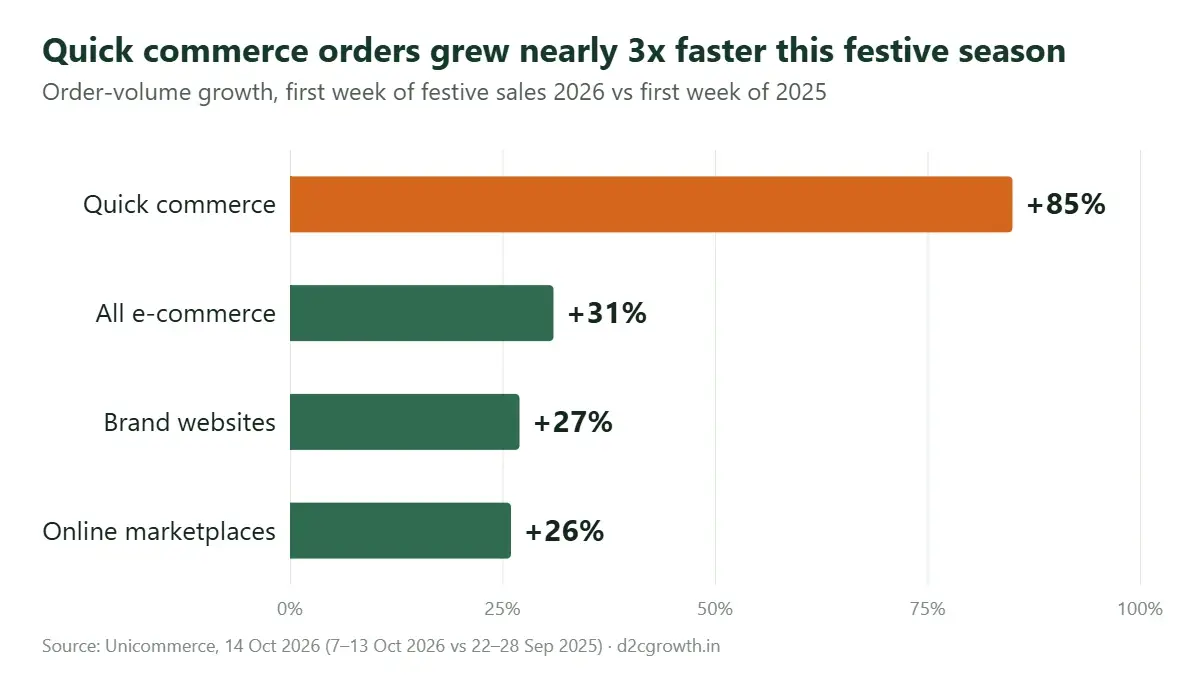
Quick commerce is now growing faster than every other online channel during the festive season. In the first week of 2026 festive sales (October 7–13), Unicommerce reported, based on more than 33 million order items processed on its platform, that quick-commerce order volumes grew 85% year on year. Overall e-commerce grew 31%, brand websites 27% and online marketplaces 26% (Free Press Journal, Deccan Herald).
The same report shows where the growth is coming from. FMCG order volumes rose more than 190%, beauty and personal care more than 69%, and home decor more than 22%. Average order value fell 10%, so shoppers are placing more, smaller orders.
Last Diwali shows how concentrated the peak is:
- Zepto said it delivered 2.1 million, 2.37 million and 2.13 million orders on October 18, 19 and 20, 2025, the days around Diwali, the highest in its history. CEO Aadit Palicha claimed 30–40% more daily orders than its closest rival on peak days (Business Standard). Blinkit and Instamart did not publish comparable numbers; Blinkit was reported at about 3 million daily orders and Instamart at about 1.44 million (Storyboard18).
- Swiggy Instamart reported a five-fold year-on-year increase in gold and silver coin sales on Dhanteras, and BigBasket reported 500% growth in electronics over Diwali, led by iPhones (Business Standard).
- Across Unicommerce’s brands, quick-commerce orders grew 120% over Diwali 2025, against 24% for e-commerce overall (Inc42).
- Across EasyEcom’s sellers, order volume fell about 70% on Diwali day itself (EasyEcom). This is all-channel data, not quick commerce alone, but the pattern holds: demand peaks in the days before Diwali, not on it.
Category spikes can be extreme. During Ganesh Chaturthi 2025, Zepto reported a 14.15x jump in decorative light sales (SocialSamosa). For a brand, a multiple like that means a dark store can sell a week of normal stock in a few hours.
Why availability beats discounts on quick commerce
On a marketplace, a customer who can’t find your product today can wait two days. On a quick-commerce app, they buy what the nearest store has right now. Each dark store holds a small slice of the catalogue, and there were about 6,280 of them in India in January 2026, according to Redseer (Inc42). Your festive sales are decided store by store.
Platforms plan this way too. BigBasket’s chief buying and merchandising officer, Vishal Das, told Inc42 that festive allocation is locked “city-wise and store cluster-wise” with “refills multiple times a day.” On Diwali 2025 he said: “Availability, convenience and the right festive assortment did more for us than headline discounts” (Inc42).
Shipsy CEO Soham Chokshi put the planning problem in one line: “Carrier capacity, warehouse space, even ad budgets can be bought late. Inventory position cannot” (Inc42). If you only fix one thing before Diwali, fix where your stock sits.
The countdown plan: what to do each week
| When | Focus | What to do |
|---|---|---|
| 3 weeks out (to about October 18) | Assortment and stock | Freeze the festive range: gift packs, combos and festive editions. Agree city and cluster allocation with your platform account manager. Book warehouse inbound slots early, because they fill up. |
| 2 weeks out (October 19–25) | Listings and search | Put festive images and titles live (“Diwali gift box”, “for puja”). Check that every festive SKU is mapped to festive categories and collections. Start search ads on event keywords at normal bids to learn which ones convert. |
| Final stretch (October 26 – November 5) | Availability and scale | Check store-level stock every day and move budget away from cities where you are out of stock. Raise bids on the keywords that converted. Defend your brand keywords so competitors can’t buy your searches. |
| Peak (November 6–8) | Dhanteras to Diwali morning | Highest bids on event keywords, concentrated on the hours people shop. Watch stock-outs hourly with your account manager. Reduce spend from Diwali afternoon onwards. |
| Tail (November 9–10) | Bhai Dooj | Keep gifting SKUs visible for Bhai Dooj, then cut bids. Plan what to do with leftover festive stock before it ages in dark stores. |
For the basics of ranking on Blinkit outside festive weeks (pricing, availability and assortment), see our Blinkit sales guide. Festive weeks amplify the same levers.
Budgeting for festive ad prices
Expect to pay more for the same placement. In August 2026, ad-tech executives told IndianTelevision they expected quick-commerce ad rates to rise 30–50% in the festive season, with homepage, category and first-screen search placements seeing the largest premiums. ReBid’s Rajiv Dingra gave an example: a keyword that costs ₹10 per click in a normal month could cost ₹14–15 on the most competitive festive days (IndianTelevision). The same experts estimated festive returns at 4–7x ROAS for well-run campaigns. Treat those as industry estimates, not targets.
Three rules make the higher prices worth paying:
- Buy event keywords, not just category keywords. BigBasket’s Seshu Kumar Tirumala said search ads on event-specific keywords deliver high ROI in festive weeks (SocialSamosa). Build the list now: “diwali gift”, “dry fruits gift box”, “diya”, “rangoli”, “puja thali”, “silver coin”, plus your category terms with “gift” added.
- Stay on search all the time during the peak. Festive buying is impulsive and last-minute. A brand that pauses ads for a day loses those searches to whoever is still bidding. An ITC Mangaldeep executive made the same point about keeping an always-on search presence (SocialSamosa).
- Only advertise where you have stock. Paying a festive click price to send a shopper to an out-of-stock listing is the most expensive mistake in quick commerce. Platforms with location targeting let you cut spend city by city; our Zepto Ads guide explains how city and pincode targeting works.
Categories to plan for
- Gifting: dry fruits, sweets, chocolates and hampers. Make a gift-ready pack with a clear price point; it competes with mithai bought on the same app.
- Puja and decor: diyas, candles, lights, rangoli and flowers. The fastest spikes and the shortest window. Many of these only sell in the last 72 hours.
- Precious metals: gold and silver coins on Dhanteras. Instamart’s five-fold jump in 2025 shows how concentrated this demand is.
- Beauty and personal care: the second-fastest-growing of the categories Unicommerce reported for the first week of 2026 festive sales. Gift sets and festive makeup sell well.
- Small electronics: earbuds, trimmers and smart devices as gifts. BigBasket’s 500% growth last year shows customers now trust quick commerce for higher-value gifts.
Operational risks that cost the most
- Delivery capacity. Adecco India estimates a 10–15% gap between demand and supply for peak frontline roles in the 2026 festive season, and TeamLease expects temporary hiring across retail, e-commerce, quick commerce and logistics to rise 15–20% (Inc42). Alvarez & Marsal’s Rishav Jain noted that a network can have enough riders across a city but too few in its outer areas, so plan for slower deliveries there.
- Inbound to platform warehouses. Bombay Shaving Company’s Deepak Gupta told Inc42 that vehicles without an unloading appointment at a marketplace facility can back up a carrier’s whole distribution centre, and late stock misses the peak. The company adds almost 50% more delivery partners in the festive period and arranges several pickups a day (Inc42).
- Growing faster than fulfilment. RENÉE Cosmetics co-founder Ashutosh Valani put it simply: “There is no point maximising order volumes during a campaign if fulfilment cannot keep pace” (Inc42).
Your account manager on each platform is the person who can move stock between clusters and flag stock-outs early. If you haven’t spoken to them about festive allocation yet, do it this week. Our guide to the key account manager role explains what they control.
Diwali checklist for quick commerce
- Festive SKUs and combos are live, with festive images and titles.
- Stock allocation agreed by city and store cluster with each platform.
- Warehouse inbound slots booked before the final stretch.
- Event keyword list built and tested at normal bids.
- Budget planned for 30–50% higher ad prices on peak days.
- Daily store-level stock report, and a rule to pause ads where you are out of stock.
- Brand keywords protected.
- A plan for Bhai Dooj and for leftover festive stock.
The bottom line
Quick commerce is now the fastest-growing festive channel in India, and its peak is short: a few days before Diwali and a small tail for Bhai Dooj. The brands that win in that window are the ones whose stock is in the right dark stores, whose listings say “gift” when people search for gifts, and whose ad money only goes where there is something to sell. Discounts come after all of that.
Keep reading
- How to Increase Sales on Blinkit: Complete Guide for D2C Brands (2026)
- Zepto Ads: Why City-Level and Pincode-Level Targeting Is the Real Story
- Inside Flipkart’s O+N Festive Calendar: Why “Big Billion Days” Is Actually Five Different Sales
- A Day in the Life of a Key Account Manager (E-commerce & Quick Commerce, 2026)
- India’s Earbuds Market in 2026: Brand Share, Channels, Quick Commerce and the China Question
Sources
- Free Press Journal: E-commerce order volumes jump 31%, quick commerce grows 85% (Oct 2026)
- Deccan Herald: Festive sales surge 31% as quick commerce orders jump 85% (Oct 2026)
- Business Standard: Zepto logs record 2 million daily orders (Oct 2025)
- Storyboard18: Zepto logged 20 lakh daily Diwali orders (Oct 2025)
- Inc42: Inside the dark store festive stock-up strategy (Aug 2026)
- Inc42: The festive delivery squeeze (Sept 2026)
- IndianTelevision: Quick commerce ad budgets set to rise 25–35% this festive season (Aug 2026)
- SocialSamosa: Q-com ad rates climb 20–30%, festive slots near 40% spike (Sept 2025)
- EasyEcom: Festive Report, Diwali 2025
- Travel India Smart: Diwali 2026 dates
- SmartPuja: Dhanteras 2026 date
Pingback: Zepto Ads: Why City-Level (and Pincode-Level) Targeting Is the Real Story - d2cgrowth.in
Pingback: How to Increase Sales on Blinkit in 2026: Pricing, Ads & Dark-Store Playbook