
Most Indian D2C brands don’t fail because the product is bad. They fail because growth gets treated as one lever — usually paid ads — instead of a system. This playbook breaks down how the D2C brands actually scaling in India in 2026 think about growth, stage by stage.
1. Get Channel Mix Right Before You Scale Anything
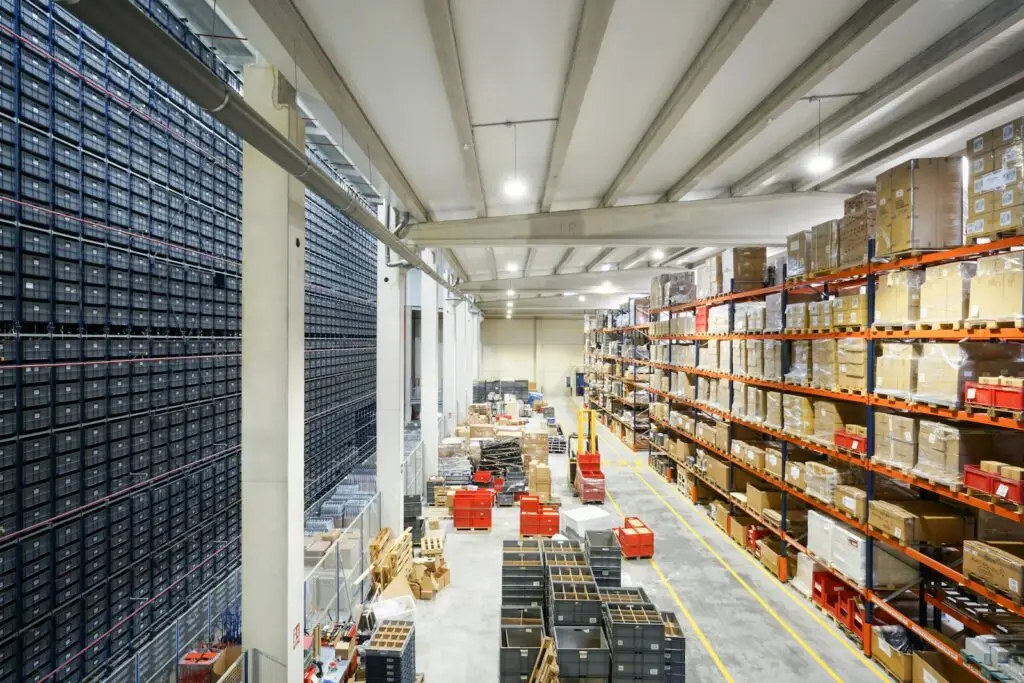
Every D2C brand in India ends up choosing some mix of three channel types, and most founders pick the wrong starting mix because it’s the easiest one, not the right one.
The three channel types
- Owned (your own website / app) — highest margin, highest control, slowest initial traffic. Best long-term asset because you own the customer data.
- Marketplace (Amazon, Flipkart, Myntra) — instant access to buyer intent, but you compete on price and visibility algorithms you don’t control. See our breakdown of Seller vs Vendor vs Strategic Seller models on Amazon for how to pick your entry model.
- Quick commerce (Blinkit, Zepto, Instamart) — fastest-growing channel in urban India right now, but unit economics are unforgiving if you don’t manage fill rate and CPMs carefully. We cover the mechanics in our guide to increasing sales on Blinkit.
A simple starting rule
If you’re pre-₹1 crore in monthly revenue, don’t try to be everywhere. Pick one marketplace or quick-commerce channel to prove product-market fit fast (you get real demand signal in weeks, not months), and use that revenue to fund building your owned channel in parallel. Trying to run all three well with a 3-person team is how brands end up mediocre everywhere instead of strong somewhere.

2. Bootstrap vs Raise: A Framework, Not a Vibe
Founders often decide to raise funding based on what’s trendy, not what the business actually needs. Three questions cut through the noise:
- Is your CAC payback period under 6 months? If yes, you can likely fund growth from cash flow and keep more equity. If it’s 12+ months, you probably need outside capital to survive the gap between spend and repeat-purchase revenue.
- Is the bottleneck capital or execution? Raising money doesn’t fix a weak team, bad unit economics, or a product without repeat purchase. Money accelerates what’s already working — it rarely fixes what’s broken.
- Do you need working capital for inventory, or growth capital for marketing? These are different problems with different solutions. Inventory financing (including some D2C-focused NBFC products in India) can solve the first without diluting equity at all.
👉 A useful gut check: if you raised ₹2 crore tomorrow, could you point to exactly what it would fund and what the expected return is? If the honest answer is “grow faster in a general sense,” you’re not ready to raise yet.
3. Build a Moat Beyond Price
Discounting works until it doesn’t — and in quick commerce and marketplaces especially, it’s a race to the bottom that only the best-funded competitor wins. Real moats for Indian D2C brands in 2026 tend to come from:
- Formulation / product IP — genuinely hard to replicate (common in F&B, skincare, supplements).
- Distribution relationships — exclusive or early access to high-growth channels (a strong dark-store relationship, early quick-commerce category leadership).
- Community and brand trust — the hardest to fake, the hardest to copy, and the slowest to build. This is the one most brands underinvest in because it doesn’t show up in next month’s numbers.
- Retention infrastructure — WhatsApp commerce, subscriptions, and post-purchase flows that turn a one-time buyer into a repeat customer. Acquisition costs keep rising across every channel in India; retention is where margin actually lives.
4. The Stage-by-Stage Growth Checklist
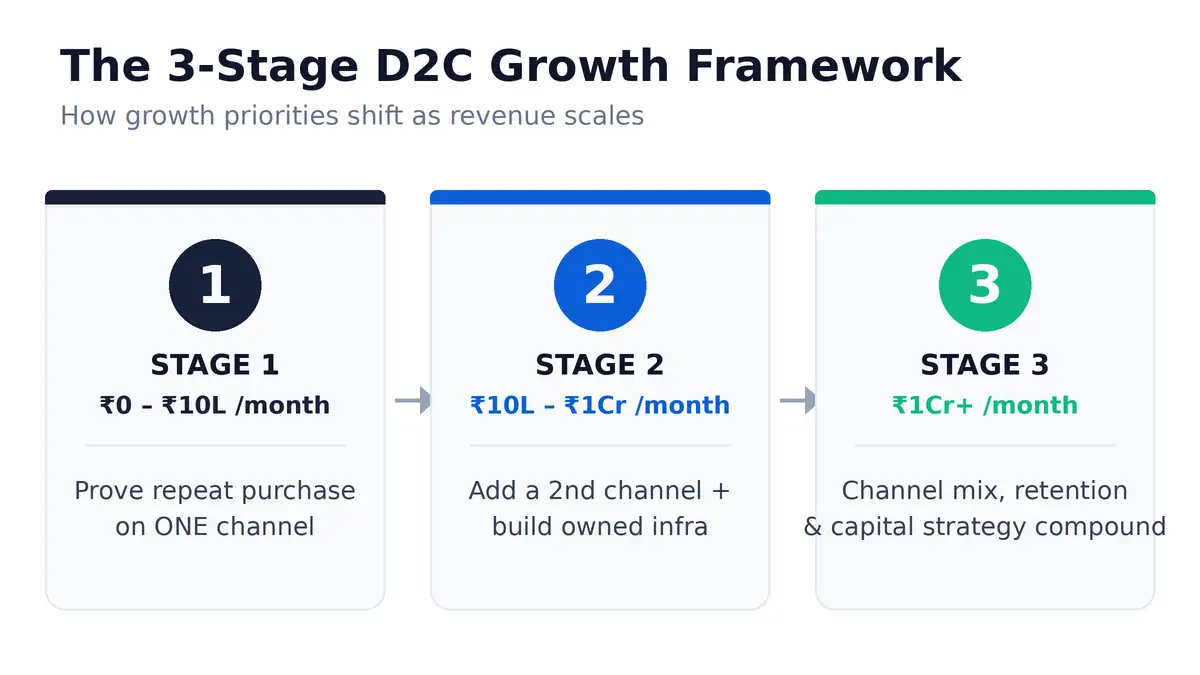
Stage 1: 0 to ₹10 lakh/month
Focus entirely on proving repeat purchase on one channel. Don’t diversify yet. Track a single number obsessively: 30-day repeat purchase rate.
Stage 2: ₹10 lakh to ₹1 crore/month
Add a second channel. Start building owned-channel infrastructure (website, WhatsApp list, email) even if it’s not the growth driver yet — you’ll need it later and it’s cheaper to build early.
Stage 3: ₹1 crore+/month
This is where channel mix, retention systems, and capital strategy all start compounding together. Decisions here (fundraise or not, which channel to double down on) have outsized impact — this is also where most of our future guides on this site will focus.
Final Thoughts
Growth for Indian D2C brands in 2026 isn’t about picking the trendiest channel — it’s about sequencing: prove demand on one channel, build owned infrastructure in parallel, and invest in retention before you need it. The brands winning right now aren’t necessarily spending the most on ads; they’re the ones who treated growth as a system instead of a scramble.
We’ll be publishing deeper guides on each piece of this playbook — Amazon seller strategy, quick-commerce optimization, paid ads budgeting, and retention systems — in the coming weeks.
Pingback: Inside Flipkart's O+N Festive Calendar: Why "Big Billion Days" Is Actually Five Different Sales - d2cgrowth.in
Pingback: Seller vs Vendor vs Strategic Seller Model on Amazon: A Complete Guide for Brands - d2cgrowth.in
Pingback: Zepto Ads: Why City-Level (and Pincode-Level) Targeting Is the Real Story - d2cgrowth.in
Pingback: Increase Sales on Blinkit: Proven Strategies for D2C Brands (2026) - d2cgrowth.in
Pingback: Winning the Amazon Buy Box in India: A Strategic Seller's Playbook (2026) - d2cgrowth.in