
The job title says “account manager,” which sounds like a customer-service role with a nicer business card. It isn’t. A Key Account Manager (KAM) at a marketplace or quick-commerce brand is closer to running a small P&L for one retailer relationship — owning the catalog, the ad spend, the fill rate, and the one negotiation every quarter that decides how much shelf space and co-funded marketing that brand actually gets. Get it right and a KAM can move a brand’s revenue on a single platform by double digits. Get it wrong and the brand finds out from a stockout, not a status update.
This is a look at what the role actually involves day to day — sourced from real job postings, published KPI frameworks, and salary data, not a generic “manage client relationships” description. It also complements our guide to the Seller vs Vendor models on Amazon and our breakdown of Zepto’s ad targeting: those cover the platforms. This one covers the person sitting between the brand and the platform, making both sides work.

What a KAM actually owns
Strip the corporate language out of real job postings for the role and a consistent list of owned outcomes shows up, not just soft-skill bullet points. A quick-commerce-focused listing spanning Blinkit, Instamart, and Zepto lays it out plainly: building and maintaining relationships with platform stakeholders, managing catalog placement and pricing for new launches, planning and executing promotional campaigns, reviewing sales and inventory data to spot growth opportunities, and coordinating with supply chain, marketing, and operations teams to keep all of it moving.1 None of that is relationship management in the soft sense — it’s operational ownership with a relationship attached.
The KAM career-path literature frames the entry-level version of the role the same way: “managing a few key accounts, developing relationships with customers, and ensuring customer satisfaction,” with the accounts themselves — not the relationship-building — as the actual unit of work.2 Success isn’t formally scored against a single KPI in most of these postings; it’s judged on sales growth against target, product visibility and availability, competitive positioning, and how cleanly campaigns and sale events get executed.1
Marketplace KAM vs quick-commerce KAM: same title, different job
“Key Account Manager” covers two genuinely different jobs depending on which side of the platform divide a brand sells into, and the KPIs each one lives inside reflect that:
| Marketplace (Amazon, Flipkart) | Quick commerce (Blinkit, Zepto, Instamart) | |
|---|---|---|
| Core unit | SKU / ASIN, nationwide | SKU, per dark store / pincode cluster |
| Headline KPI | Buy Box / Featured Offer win rate | Fill rate and on-shelf availability (OSA) |
| Ad metric | ACOS (cost of sales) | ROAS, in-app search rank |
| Planning cycle | Event-driven (BBD, Great Indian Festival) | Continuous, plus a formal quarterly/annual JBP |
| Biggest operational risk | Account health dropping Buy Box eligibility | A single dark store going out of stock and killing local search visibility |
The quick-commerce side is the newer and less-documented discipline, and it inherits its intensity from the format itself: a 10–30 minute delivery promise means there’s no buffer between a KAM missing a stockout and a customer seeing “out of stock” on the app. Real-time inventory sync per dark store exists specifically “to prevent cancellations and protect search visibility” — a sentence that doubles as most quick-commerce KAMs’ actual job description.3
The KPIs that actually run their calendar
On-shelf availability (OSA) is the single most consequential number in the quick-commerce version of the job, and it’s stricter than it sounds: it measures the percentage of a defined SKU list that’s physically present and purchasable right now, not just “in stock somewhere in the warehouse.” The formula is blunt — SKUs actually available, divided by total SKUs in the assortment, times 100 — and a product sitting in a back room doesn’t count.4 Industry targets run 97–99% for a retailer’s top SKUs in grocery, 90–94% in convenience formats, and sustained OSA under 85% is treated as a systemic failure requiring intervention, not a rounding error.4 The stakes behind that number are real: out-of-stock events are estimated to cost global retail 8–10% of total sales annually, largely because shoppers who can’t find a product don’t reliably come back for the substitute.4
Underneath OSA sits a cluster of operational metrics a quick-commerce KAM is judged on weekly: fill rate, wastage percentage, cancellation rate, and repeat purchase rate on the operations side, plus ROAS, order volume, average order value, in-app search rank, and cities-live coverage on the growth side.3 On the marketplace side, the equivalent list runs through Buy Box/Featured Offer win rate, ACOS on Sponsored Products spend, and account-health metrics like Order Defect Rate — the same account-health gate covered in our Buy Box breakdown.
What an actual day looks like
Strip out the generic “attend meetings, build relationships” filler and a realistic day, reconstructed from the responsibilities and KPIs above, looks something like this:
- Morning: dashboards first, before anything else — overnight OSA/stockout alerts across dark stores or ASINs, any account-health flags, and yesterday’s ad spend efficiency (ROAS or ACOS) against target. Anything red gets triaged before the first meeting.
- Mid-morning: catalog and listing work — new SKU onboarding, pricing updates, content fixes for anything flagged by the platform’s own quality checks, competitor price benchmarking.
- Midday: internal coordination — supply chain on stock allocation, marketing on the next campaign or sale-event calendar, sometimes finance on trade-spend accruals.
- Afternoon: the platform-facing calls — a category manager on Blinkit or Instamart, a vendor manager on Amazon, or an ads team lead — reviewing performance, negotiating placement or promotional slots, or prepping for the next Joint Business Plan cycle (more on that below).
- Evening: firefighting. A dark store going dark before a flash sale, a listing getting suppressed, a competitor undercutting price on a hero SKU — the job’s bursty, event-driven side, concentrated disproportionately around festive-sale windows.
What doesn’t show up on that list, but shapes almost everything on it: a KAM rarely controls the things they’re measured on. Stock allocation sits with supply chain, creative sits with marketing, and pricing floors sit with finance — the KAM’s actual skill is coordinating all three fast enough that the platform-facing number doesn’t slip while the internal handoffs happen.
The one meeting that shapes the whole quarter: the JBP
The Joint Business Plan (JBP) is the closest thing this role has to a single defining event. It’s a collaborative planning document negotiated between a brand and a retailer or platform, aligning both sides on sales targets, product placement, pricing, and new-launch coordination for the period ahead — and on the more mature end, demand forecasting and localized assortment strategy too.5 On the quick-commerce side specifically, agencies managing this process describe building “quarterly and annual business plans alongside platform leadership, locking in co-funded campaigns” and seasonal promotions as a core deliverable, done in direct coordination with the platform’s own category managers and ads teams.6
The negotiation isn’t abstract. One agency’s documented client results from exactly this kind of platform relationship management show the scale of what’s actually being moved in these conversations: Total ACOS brought down from 63% to 32% for one brand, and ROAS improved from 2.4 to 7.6 within four months for another — the kind of swing that comes from renegotiated placement and ad terms, not incremental tweaking.6 A JBP that goes well can fund a quarter’s worth of co-marketing; one that goes badly means paying full price for shelf space a competitor got subsidized.

What it pays, and where it goes next
Fixed compensation for the role in India climbs steadily and substantially with experience, though it starts modest relative to the operational weight of the job:
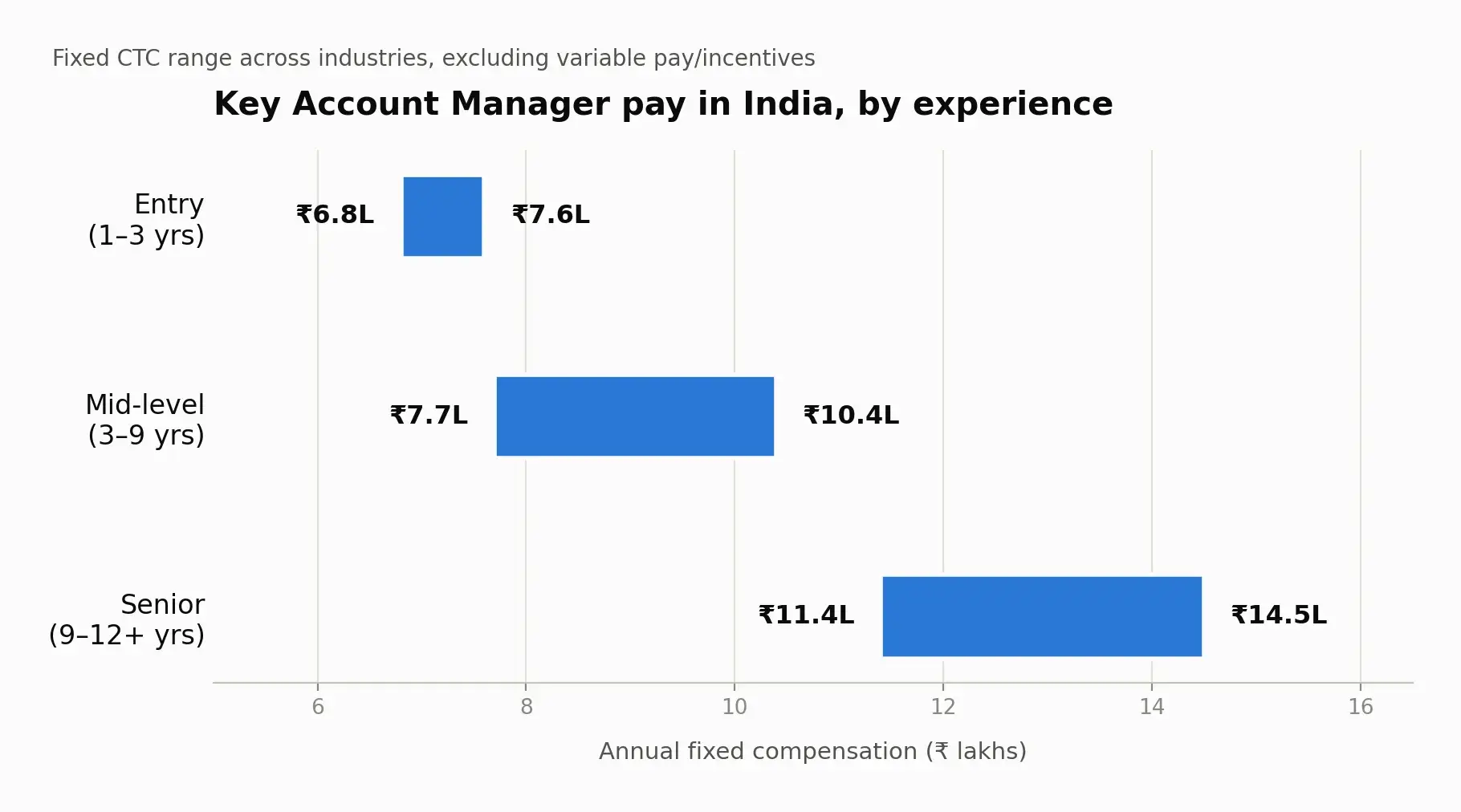
Entry-level KAMs (roughly 1–3 years) sit in the ₹6.8–7.6 lakh range; mid-level (3–9 years) moves to ₹7.7–10.4 lakh; and senior KAMs (9–12+ years) reach ₹11.4–14.5 lakh in fixed pay.7 Consumer electronics and appliances pay the highest premium among industries sampled (₹15.4–17.1 lakh), with software product and IT services close behind; Gurugram, Mumbai, and Bengaluru command the highest city-level pay.7 None of these figures include the variable/incentive component tied to account performance that most of these roles carry on top — which, given how directly a KAM’s work maps to a measurable number like OSA or ROAS, tends to be a meaningfully sized slice of total compensation rather than a token bonus.
The career path from there runs fairly predictably: Key Account Manager → Senior Key Account Manager (larger accounts, often a small team) → Global or National Key Account Manager (multi-region or multi-platform ownership) → Director of Key Accounts → VP of Sales.2 The exact pace depends heavily on company size and how fast the accounts under management grow — a KAM who takes a platform relationship from ₹2 crore to ₹20 crore in annual GMV moves faster than the title ladder alone would suggest.
The bottom line
The KAM role is one of the few jobs in ecommerce and quick commerce where a single person’s day genuinely spans a spreadsheet, a warehouse problem, and a negotiation — often before lunch. It pays modestly at entry level relative to the operational risk it carries, but the ceiling is real: the same skill set that keeps OSA above 95% and ACOS under control is exactly what a brand needs managing its two or three biggest revenue channels as those channels scale. For a brand evaluating whether to hire one, the honest framing is that a good KAM doesn’t just maintain a relationship — they run a P&L you don’t have to think about until something goes wrong.
Keep reading: Seller vs Vendor vs Strategic Seller Model on Amazon — for the ownership structures a marketplace KAM operates inside — or Zepto Ads: Why City-Level and Pincode-Level Targeting Is the Real Story for the platform-side mechanics a quick-commerce KAM negotiates against.
Sources
- Two Brothers India Shop, “Key Account Manager – Quick Commerce” (job posting).
- DemandFarm, “Key Account Manager Career Path Options Guide.”
- BrandChanakya, “Quick Commerce in India: Complete Guide for Brands 2026.”
- Fieldpie, “What Is OSA KPI and How Does It Impact Retail Execution?”
- SPS Commerce, “What is a Joint Business Plan (JBP) in Retail?”
- AKOI, “Quick-Commerce Marketing Services.”
- upGrad, “Key Account Manager Salary in India 2026: A Complete Guide.”
Hiring or structuring a KAM function for your brand’s marketplace or quick-commerce channels? Reach out via the Contact page.